Home / Latest News / You may be interested in / AEB Informs / “Spain’s economy’s future depends on foreign markets”
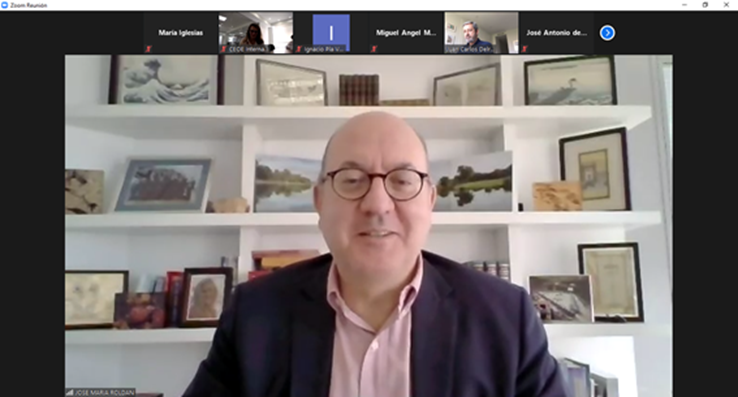
The President of the Spanish Banking Association warned of the “unavoidable” need to maintain market confidence in the Spanish economy, as it is essential to finance the current volume of external debt, equivalent to 170% of GDP, plus new needs arising from the COVID-19 crisis. “Spain’s economy’s future depends on the foreign sector,” stated José María Roldán at a meeting with business representatives from the CEOE International Relations Commission.
In this regard, he drew attention to the fact that Spain will possibly face a double deficit, public and current account, as the fundamental contribution made by the tourism sector to this item cannot be relied upon for the time being. For all these reasons, he called for extra support for this sector, which he considered strategic for the Spanish economy and irreplaceable in the short term, as well as for exporting companies: “our progress as a country depends on the foreign sector.”
He also encouraged companies to ask the Government for direct and non-reimbursable aid, as most countries in our environment are doing. Specifically, he referred to the aid that French and German companies are receiving, which is much higher than that for Spanish companies, allowing them to compete with an advantage. “The ease with which State aid rules have been repealed in Europe is surprising. When France and Germany have problems, the rules quickly disappear, which does not happen when the problems are those of other countries.”
In his opinion, these capital aids or subsidies are necessary, among other reasons, because banks cannot be burdened with the adjustment of the entire Spanish economy. “Banks are willing to help, but they cannot do everything,” said the President of AEB, who asked to preserve the sector so that it can continue to fulfill its absolutely fundamental function of financing companies and families, as it has done until now.
He also addressed the situation of Spanish banking after the crisis and its willingness to help the business fabric in its recovery. Specifically, he referred to the important role our banks play in financing exports and the support companies receive in countries where our banks are present. All this is thanks to the advantages offered by the internationalization model of the Spanish banking sector. “The independent subsidiary model demands more financial discipline but provides great resilience to our sector. It was key in the last crisis and will be so in this one too,” added the President of the AEB.
Finally, he highlighted the fact that resolution rules were suspended at the first sign of a systemic crisis, without ever having been applied, except in Spain. “Consequently, we should also cancel the banks’ contribution to the Single Resolution Fund, a possibility included in the Fund’s own regulations,” proposed José María Roldán in his digital meeting with CEOE Internacional.
José María Roldán, Chairman of the Spanish Banking Association