Home / Latest News / You may be interested in / AEB Informs / Banks defend payment interoperability and wholesale digital euro as pillars of European strategic autonomy
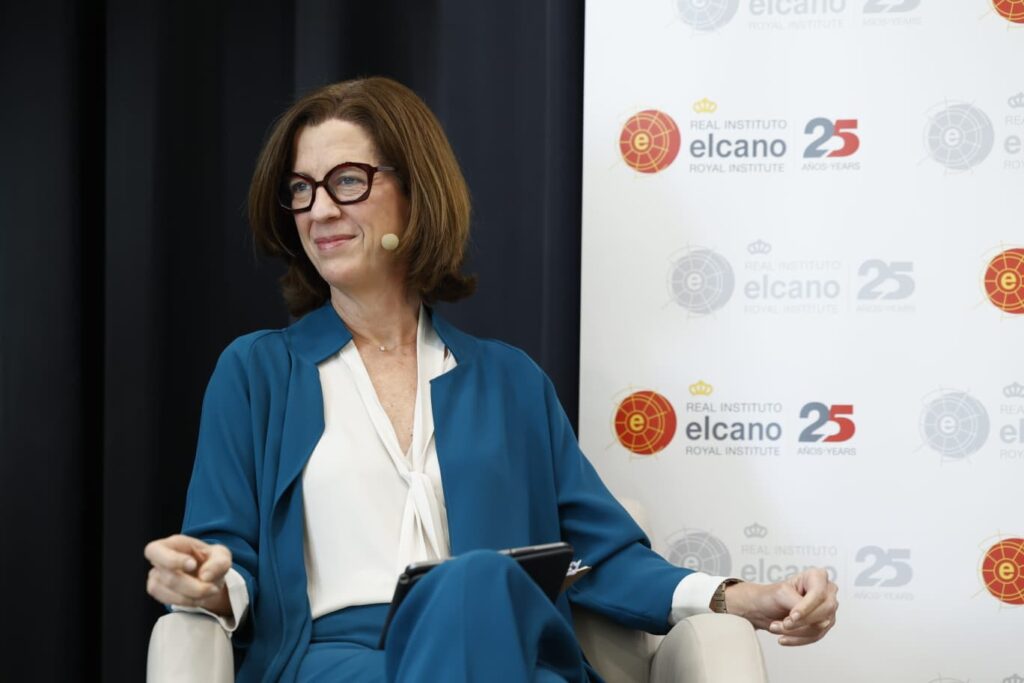
The president of the Spanish Banking Association (AEB), Alejandra Kindelán, today underlined the banking sector’s firm commitment to contribute to European strategic autonomy through the development of payment interoperability in order to consolidate Europe’s role in the world.
During the conference ‘Why do we want a digital euro?’ of the Elcano Royal Institute on the transformation of money, Kindelán explained that the objective is for Europe to have its own alternatives to the large international card schemes.
In this regard, he highlighted the work done by banks to promote private European digital payment solutions, giving as an example the case of Bizum, created by Spanish banks in 2016 and currently used by more than 31 million citizens.
Bizum is already interoperable with the equivalent systems in Italy and Portugal, allowing instant payments between users in these countries without the need to use separate applications.
This interoperability will be extended and, expected between the end of 2026 and the beginning of 2027, will allow users to make instant payments with Germany, Belgium, Holland, France and Nordic countries, reaching a potential market of 135 million users in 13 European countries.
In addition, Kindelán emphasized that Bizum will continue to expand its e-commerce and physical merchant payment functionalities across Europe, thus reinforcing the existence of a European digital payments infrastructure of its own.
Euro digital wholesale
Regarding the digital euro, Kindelán defended the need to urgently advance in the development of the wholesale digital euro, oriented to operations between financial institutions and markets, an area in which he considered that there are clear opportunities to improve efficiency and competitiveness for Europe.
The digital euro, said the president of the AEB, should act as a complementary solution within the payments ecosystem, coexisting with existing private initiatives.
In addition, he highlighted its usefulness for offline payments, allowing digital money transfers even without an internet connection, similar to the current use of cash.
The president explained that the banking sector is actively participating in the working groups promoted by the European Central Bank to design the future digital euro and that it fully shares the objectives of the project: to strengthen European strategic autonomy, improve the efficiency of payments and complete the integration of the European digital payments ecosystem.