Home / Latest News / You may be interested in / Interviews / “The bank tax is based on two fallacies regarding interest rates and the bank bailout”
INTERVIEW
Being an economist, possessing a diplomatic character, and having a certain cosmopolitan air facilitates her dialogue and negotiation on matters of concern and interest to the banking sector with authorities and social representatives. It also allows her to reflect on the many great challenges facing the sector she represents.
What has occupied and concerned you the most during the year and a half that you have been at the head of the AEB?
What has occupied me the most has been getting to know the banking sector. I spent 28 years at a fantastic institution, where I trained at many levels, but the financial sector in Spain is very large and diverse. It has large international entities, but also medium, small, and very local entities.
I have been concerned with understanding the sector and knowing its motivations and business models. Another of my occupations has been to establish a relationship and a dialogue from the sector, no longer from a single entity, with the authorities on certain issues.
There have been many important issues for the AEB in recent months. Issues of financial education, care for the elderly, rural Spain, mortgages, the sector tax, etc. On the other hand, we have been concerned with making known the strengths of banking and the mission of the banking sector in our society.
What image of Spanish banking have you found? Have you found a better or worse reputation than you expected?
I believe that when we talk about reputation, it is important to talk about trust. And citizens trust their banks—a great deal, in fact—because we have measured it perfectly.
Our sector is strong, profitable, and has financial strength, but it also has good products and services that respond to the needs of customers. We have a branch network that has been reduced in the last decade, but it remains the third densest branch network in Europe today. It is a banking system that is in contact with its customers, and all of that provides security and trust. Furthermore, we have a regulatory framework that also provides security.
We can say that banks in Spain have business models that are profitable because they have financial strength. Moreover, they are entities sensitive to the problems and challenges facing society today, as has been very clearly demonstrated in recent years. During COVID, for example, the sector showed its vocation to support customers in both good and bad times.
Reputation is many things, but at its core is trust.
Some say that banking will never be able to have a good reputation, neither in Spain nor anywhere else in the world. But perhaps something can be done to improve it.
I believe it can and must be done. We must talk, explain, and communicate what we are doing here and now. What does the sector do? What is its mission? We must try to explain that we support families, companies, the self-employed, and entrepreneurs to make citizens’ lives easier. We must mention that in Spain we have a payment system that is possibly the most advanced in the world. The banking sector is hiring thousands of computer engineers to provide the most agile solutions to customer demand. And we must also mention that there was no bailout of the banks, but rather of other types of entities that, moreover, had a lot of political interference. And we are dedicating ourselves a lot to that at the AEB, because it is the way to improve those possible image problems.
It is clear that Spanish banking does not need financial resources at this time and that low rates have harmed it in recent years, but should it not share its good results at this time not only with its shareholders, but also with its customers, by remunerating deposits? Would that not also be a good decision to improve its reputation?
Regarding the issue of remunerating deposits, the AEB can say little, because these are commercial practices and, as an association, we are very close to the National Markets and Competition Commission (CNMC), which is always attentive to anything we say on this matter.
But when this specific issue is raised, I always speak, in general, about two matters. One is the environment in which it occurred. Because interest rates began to rise barely a year ago and from negative rates. They turned around very quickly. Furthermore, we came from a period in which there was excess liquidity, as there still is now. Banks today are returning liquidity to the European Central Bank, so there was no incentive to remunerate deposits.
On the other hand, they have already begun to remunerate deposits, as the average remuneration, according to the latest data we have, is 2.20%. It is true that it is slightly below the European average, but it is converging rapidly with it.
It must be taken into account that we have a lot of offers from banks of all types—large, small, digital, and non-digital. I believe we have moved with a certain delay because there was more liquidity in the banks in the Spanish system than in the banks of other European countries. But that convergence is taking place.
The European Commission has placed obstacles on the collection of retrocessions in the marketing of investment funds when entities do not really provide added value and are mere custodians of these assets. On the other hand, the Commission is aiming for companies to achieve financing through other sources without needing to resort to banks. Is the scenario becoming increasingly difficult for financial entities in Europe?
Firstly, I believe we cannot demonize commissions because there are costs behind every product and every service offered, whether from banking or any other sector. And these costs must be explained.
I remember when we talked about ATM commissions because, since the money belonged to the customers, they would have the right for the operation to be free. But of course, many times behind every operation there are systems, people, data, energy costs, security costs, and a lot of things that you have to pass on in some way to customers or non-customers. It is important that we understand the origin of commissions, because our regulator requires us to be very transparent and charge commissions that reflect the actual costs of any product or service. This is not an NGO; if there are costs, they must be passed on, and it is very important that we always keep this in mind, and it is our mission to explain it.
And in the case of retrocessions?
Regarding retrocessions, there are costs associated with the distribution of products through commercial networks that we must be able to pass on. You can charge those costs as an implicit or explicit commission, and it seems to us that the current system of retrocessions allows you to mutualize those costs behind the distribution of products. Mutualization allows this type of advisory service to reach everyone, regardless of economic level, because it dilutes the costs better. We think it would be good to maintain that system. Let’s look at the experiences in other countries, for example, in the United Kingdom. There, retrocessions were banned, and an exclusion problem occurred, with people left without that advisory service. We believe care must be taken and that it is good to find a balance and ensure that there will not be an exclusion problem.
Has the time not come for the public and private sectors to conduct a campaign at the same time that addresses the improvement of financial culture in Spain?
We are working hard on that. Last year, during Financial Education Week, the Bank of Spain, the CNMV, and the Ministry of Economy gave us an award for our work in favor of financial education. And why this award? Because we launched an initiative to include all the training, financial education, and digital training resources that the associations of banks, savings banks, and credit cooperatives have in a single portal. There, we have everything from podcasts for people of a certain age to stories for children.
I believe that by working more closely together, we will surely come out ahead. Furthermore, we have the challenge and the opportunity to use digital tools to reach more people.
Are you concerned that new technologies might overwhelm the banking sector?
I believe that technology is at the service of humans. And now it is very fashionable to say that it should be a co-pilot and not replace, but help complement. I believe in that model.
Now we have the ATM which allows us to be more agile and also more efficient; the same applies in the field of products and services: there is a part of the process that technology facilitates. A robot can offer you a price comparison, an offer of products from which you can choose at any time.
I am not concerned about the banking sector being overwhelmed by the development of new technologies. We must see new technologies as an opportunity to be more agile, to provide better service to our customers, so they have access to services and our products 24 hours a day, seven days a week, instantly and in a more personalized way.
We must also be able to train a portion of our customers who perhaps do not have the technical or digital skills. We are investing heavily in digital training. Just as we talk about financial education, we talk about digital training, especially for the elderly, because we want them to also be able, if they wish, to have access to this digital world.
Does that mean that human advice could eventually be given by a robot?
Digitalization helps us to be closer to our customers and provide them with more facilities; it leads the sector to be more agile, faster, and to seek solutions. I believe that is being very good for the sector and is making us better.
Does that replace human judgment, the accompaniment of the person who knows you, knows where you come from and where you are today? Of course not.
I believe that a sense of humor, even the affection of a branch manager, who sometimes calls a customer to congratulate them on their birthday and reminds them that they are reaching a certain age and need to think about their pension… I know that something like that is difficult for a robot to do. A person does it with much more affection than a robot.
But technology is also attracting large companies like Amazon and Google to the financial sector… And that could be tough competition.
I also want to be very clear here. The fact that they offer financial products or services does not mean they do banking, because we banks are the only ones whose mission is to finance the real economy. Amazon or Google or any other can offer a mortgage or a specific product, but they do not have the mission of financing the economy in their DNA. It is important that we know this, and what we always ask for is a level playing field—the same regulation for the same activity.
Some large technology companies are already competing with banks in attracting financial resources.
Competition is always good, and the banking sector, especially in Spain, is a sector absolutely open to it. We love to compete because we are very good at competing. That is why banking has been exported from the Spanish sector. Spanish banking competes in markets that are complicated, such as the United Kingdom and the United States, and also in Latin American countries. Competition does not scare us, and it is good for the sector. But having said that, as always, we need a level playing field, the same rules for everyone. There are supermarkets that can occasionally offer a product, but they are not going to replace banks. Because banking has a mission as a sector to accompany, to generate progress, and to finance the real economy. A company that is not a bank may occasionally offer a loan, but if that line of business does not go well, maybe next year they will no longer offer it.
Banks live off that—taking deposits and giving loans.
Should we assume that, every so often, somewhere on the planet there will be a bank in difficulty and that will create anxiety among shareholders and bank customers worldwide?
Much work has been done since the great financial crisis of 2008 to reduce the probability of crises and also to reduce the cost of those that may arise. I believe that eliminating the risk of crisis is impossible, because the economy is very dynamic, globalized, and interconnected, and a certain seismic movement can arise, such as the one generated here in Europe by what happened in the United States last spring.
It is impossible to avoid crises entirely, but work has been done on a regulatory and supervisory framework that has created new lines of defense, new trenches to reinforce the sector and reduce the probability of crisis. I mean that the capital banks hold has been increased and multiplied, but the quality of that capital has also improved. Supervision has become more intensive, and stress tests were introduced. On the other hand, much work was done on a crisis management framework. Finally, work has been done at the European level on what we call the Banking Union, which is very important. Today we have a single supervisor and also a single crisis resolution framework. We are only missing one thing, which is very important, and that is the single deposit guarantee fund.
That guarantee fund will allow banks to be valued not by their nationality or their, let’s say, place of residence, but by their solvency and their financial strength. Furthermore, it will ensure that customers have the same level of deposit coverage, wherever they are, which will provide a lot of stability.
Do you believe that at some point Germany will accept the creation of the Single European Deposit Guarantee Fund?
We have been having these conversations for some time. That discussion is on the table, and we should consider it if we want to have the ambition of having European banks with the power and capacity to finance all the challenges facing the European economy today (the green transition, the digital transition, investments in defense).
It is true that we also need European capital markets. I am not saying we don’t. And for that reason, we must work on the Capital Markets Union, but I believe the Banking Union must be completed.
Let’s talk about the temporary extraordinary tax on banking results. Do you believe its future will depend on who comes to govern in Spain? Italy, which does not have a left-wing government, passed a law that it later rectified, but which raised the need for these extraordinary banking profits to finance part of public spending. What do you think of this?
The bank tax was proposed in Spain as a temporary tax, but we have appealed it, even if it is temporary. Because it seems to us that it is based on two fallacies. We always say that it is true that banking profitability levels are normalizing because interest rates are normalizing. What was extraordinary was the decade of zero or negative interest rates that we have seen in Europe. The normal thing is to have positive interest rates. It is true that the change has been very drastic and that this is being noticed in margins, but it is also true that we are in a very uncertain environment in which there is an economic slowdown that will affect the activity of banks. And that is already being noticed.
On the other hand, it is possible that we may start to see some delinquency at some point. We are fortunate that for now we are not seeing it, but it is logical that this change in cycle could affect economic evolution negatively.
Therefore, one can no longer speak of extraordinary income, but of a normalization or a change in cycle that is being reflected in the banks.
The other premise on which the tax was built is the bank bailout. The banks were not bailed out, and it cannot be an argument for paying this extraordinary tax. Other types of entities that were poorly managed and had great political interference were bailed out.
That said, it is also argued that we must pitch in. We are working on a lot of issues, being very sensitive to the situation in which many Spanish families find themselves. We have worked on improving service to the elderly, facilitating financial inclusion in rural Spain, and easing the situation for mortgage debtors who have seen a significant increase in their installments, through the code of good practices that we agreed upon in collaboration with the Government.
What is your opinion on the bill that creates the independent administrative authority for the defense of financial customers?
We understand that this European directive had to be transposed, but since we saw the first texts, which have been amended in some important aspects, we already said that we did not see it necessary to create a new body. We considered it a better option, in line with what has been done in other countries, to improve or adjust some aspects of what exists at the Bank of Spain, the CNMV, and the Directorate General of Insurance. We do not see major problems in these claims services, although what exists can be improved.
The only experience similar to what the Spanish Government proposes is the one we have in the United Kingdom, which was designed for 300 workers and with the objective of reducing litigation, and both the structure and the number of claims have multiplied.
It is true that during the parliamentary process some aspects have been qualified, such as the financing formula, which proposed a fee of 250 euros per claim to be paid by the banks regardless of who was right. This and other aspects were no longer in the last text that lapsed due to the calling of elections.
You have held positions in the banking sector that were not common for women to hold. You are also the first female president of the AEB. If I ask you if you are a feminist, does that put you in a difficult position?
If being a feminist is believing in women, in their strength and their capabilities, then I am a feminist. Of course I am. I believe very much in the strength of women, and it is something that, moreover, I am passionate about. It gives me a lot of energy to think about how we have progressed and the position of women in all areas of society and also the economy.
Now, when I look at our sector, I feel especially proud. We have a chairwoman at a bank, a CEO of a relevant entity, general managers, heads of strategy, and heads of business—no longer just heads of back-office areas, but also at the forefront of business and strategy. All of that, honestly, gives me great satisfaction, just as when I see it in public life, when I see that in our dialogue with the various ministries, there are fantastic women. All of that has changed spectacularly.
A WELL-DOCUMENTED DIPLOMAT
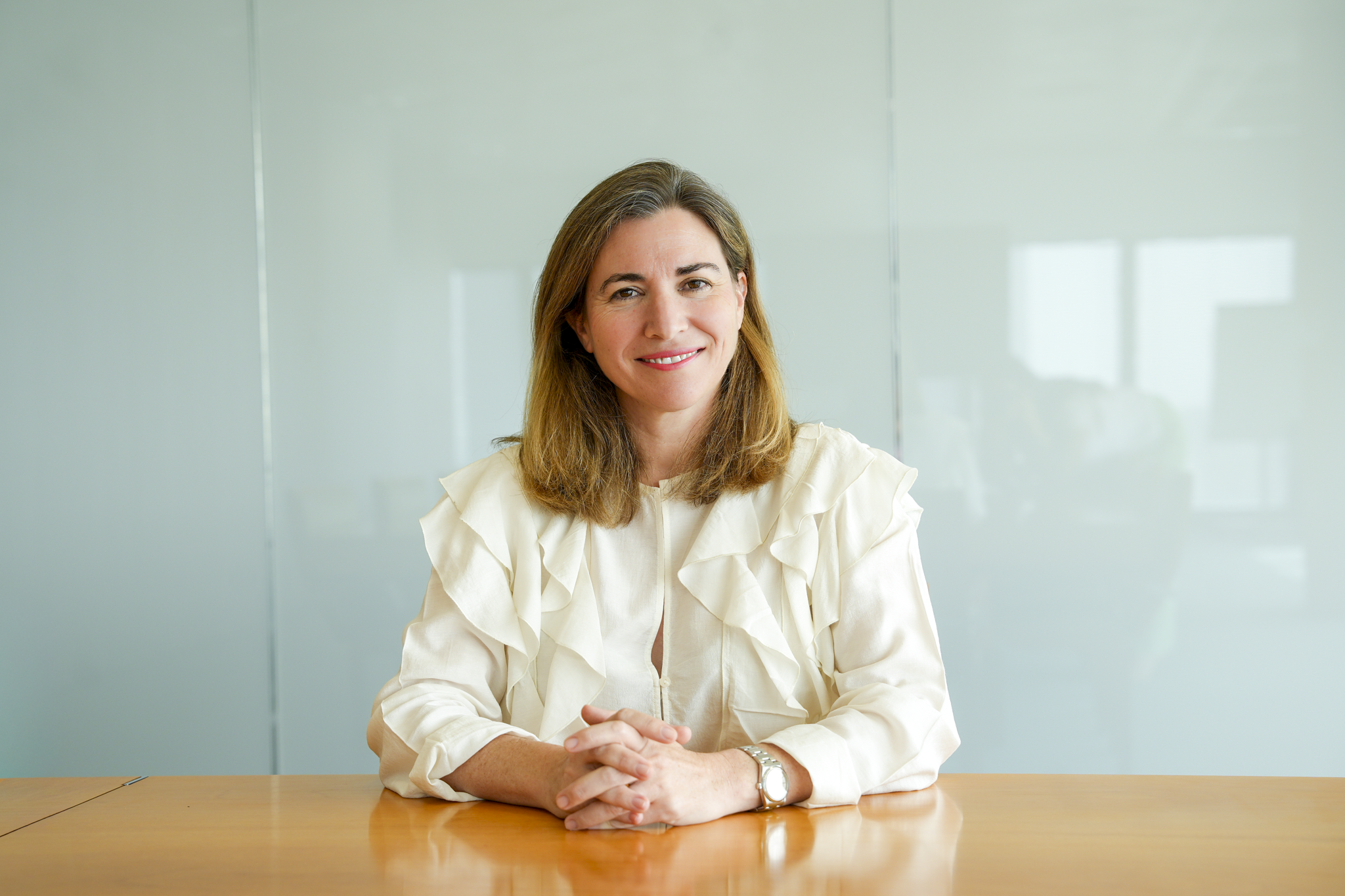
They say that the main virtue of the president and CEO of the Spanish Banking Association (AEB) is her diplomatic character, which usually means she has a great capacity for negotiation using good manners.
Alejandra Kindelán y Oteyza (1971) had four grandparents of different nationalities and a family conviction that a good education was very important. A graduate in Economics and Political Science from Wellesley College (Massachusetts), she was born in Caracas and has lived in the United Kingdom and the United States.
She was a consultant for the World Bank in Washington, and when she landed in Spain, she joined the Research Department of Banco Central Hispano. The merger of this entity with Santander led her in 2001 to become head of the Research Service of the bank now chaired by Ana Botín, undoubtedly her main supporter in becoming the first female president of the AEB a year and a half ago.
Recalling her predecessors at the head of the banking association, she says she would have liked to meet and have long talks with Rafael Termes. And those of us who lived through the birth of the AEB can only confirm that she would have enjoyed it, especially with those walks in the mountains that she likes so much.
She is now preparing a meeting with the rest of the four presidents of the association and is always ready, together with the spokesperson for the Confederation of Savings Banks (CECA) and the National Union of Credit Cooperatives (UNACC), to dialogue with the government official of the day on any aspect that concerns and interests the Spanish financial sector.
Interview conducted by Rafael Rubio. Photos by Álex Rivera.