Home / Latest News / You may be interested in / Interviews / “Mortgages in Spain are nearly one percentage point cheaper than in the EU as a whole”
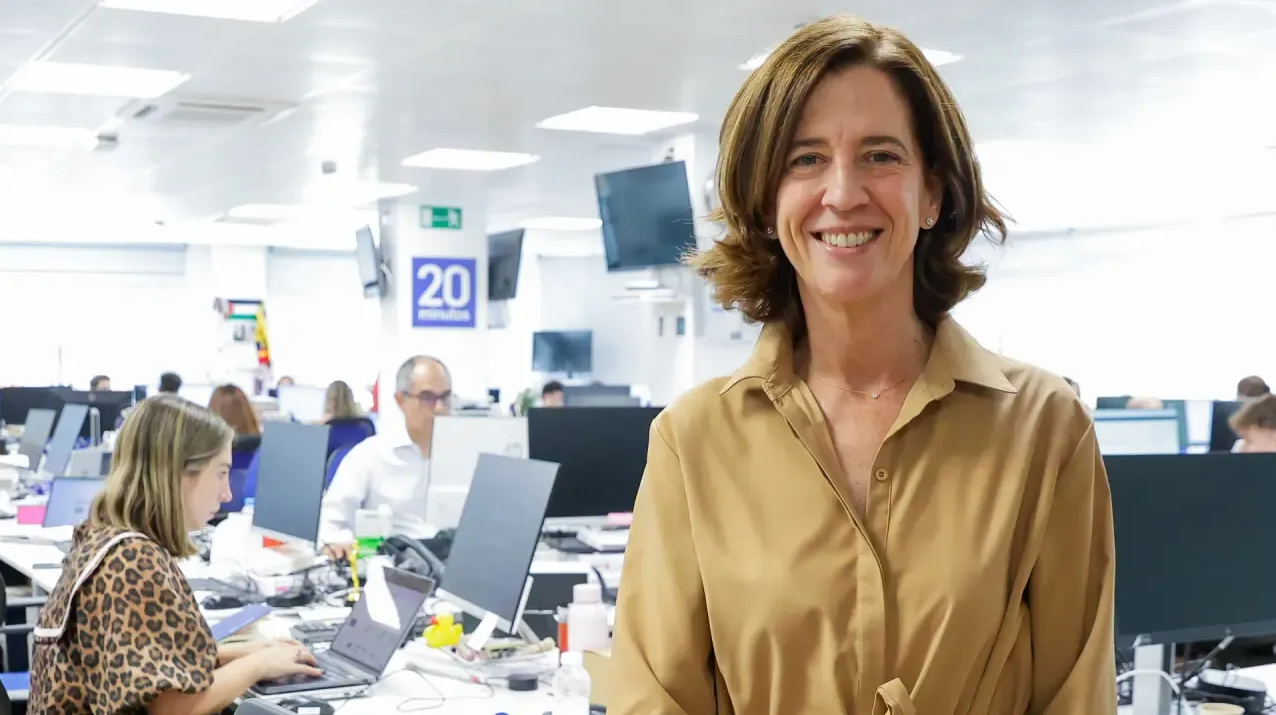
Interview in the newspaper 20 minutos
Alejandra Kindelán (Venezuela, 1971) has been president of the AEB since 2022 and serves as one of the vice presidents of the CEOE. From 2017 to 2023, she was executive vice president of the OECD Business Advisory Council. Between 2006 and 2012, she chaired the Economic and Monetary Affairs Committee of the European Banking Federation.
The president of the Spanish Banking Association (AEB) explains the challenges facing the association, including banking union in Europe
Alejandra Kindelán, the first woman to head the Spanish Banking Association (AEB), recently was reappointed as president of the banking industry association for another four years. She took office in 2022 and has had to navigate a period marked by geopolitical instability, rising interest rates—which have allowed the sector to shatter profit records—and the banking tax. In an interview with La Información Económica, she discusses the challenges posed by tensions in the Middle East and the development of the banking union in Europe.
The competition authority is investigating Ibex-listed banks for revealing their fixed-rate mortgage policies in advance. Do you think they have violated the law?
I am certain that banks comply with competition laws. And as for mortgages in Spain, we have the lowest rates in the eurozone, second only to Malta and nearly one percentage point below the European average.
The first half of the year is about to end. What can we expect from this first part of the year?
The banking sector is doing well. After a few difficult years, navigating between zero and negative interest rates, the sector has managed to return to profitability. The sector is strong, but that doesn’t mean it doesn’t still face challenges ahead. We live in an increasingly polarized and fragmented world in which Europe has barely grown over the past two decades. Spain stands out from this trend, demonstrating dynamism and even experiencing population growth. Europe must find its place, and the banking sector plays an essential role in helping to improve the region’s growth and competitiveness in the face of enormous financing needs in the areas of security, defense, and energy infrastructure. All of this requires investment. It is true that interest rates have risen, but Spanish banks are passing on that increase to the cost of credit to a lesser extent.
The European Central Bank (ECB) has raised interest rates by 25 basis points. Are you concerned that the effects of the war in Iran might eventually spill over into the real economy?
It is true that inflation is one point above the target set by the ECB, but the rise in the CPI resulting from the conflict in the Middle East is less pronounced than that seen during the war in Ukraine. The economy—especially the Spanish economy—has certain strengths that make it better positioned than others to weather this uptick. In any case, the ECB’s decisions will be shaped by the trade-off it makes between controlling inflation and fostering growth. The banking sector has the capacity to maintain its lending volume and financial stability should the war in Iran drag on longer than expected.
As we await the European Commission’s July report on the banking sector’s competitiveness, some experts argue that Europe is overdiagnosed. What is going wrong?
It is time to take action—and urgently. For 20 years, the Old Continent has been experiencing growth rates lower than we would like to see. Europe must find its place in an increasingly polarized and fragmented world. We must grow to compete, and that requires significant investment, but for that to happen, two conditions must be met: simplifying the regulatory and supervisory framework and promoting the integration of financial markets by removing barriers. A European bank operating in a single country is accountable to 22 agencies, often with overlapping layers of rules and regulations. We must remove barriers to the banking and financial markets through the banking union. Although anti-money laundering rules are harmonized, consumer protection remains the responsibility of each individual country. This also means having a single deposit insurance fund.
The development of the defense, energy, and food industries falls under the umbrella of strategic autonomy. Could the integration of capital markets be classified under this umbrella?
The banking union and the integration of capital markets in Europe are key to strategic autonomy. We cannot be competitive unless we achieve greater harmonization and integrate our financial capabilities. To achieve our goals in the areas of energy, security, and defense, we need financing, and at present, the banking sector accounts for 80% of investment needs. It is essential that the banking sector and the markets work together to ensure that all those savings—currently amounting to some 300,000 million—that are being channeled to the U.S. remain in Europe.
AEB has been critical of the banking tax.
The banking sector’s contribution to the welfare state through taxes is unquestionable. On top of all that, we have a tax that, in a sense, taxes the sector’s margins twice, because it is levied on both interest margins and fees—which is the same as the corporate income tax. We see this problem of double taxation. It is a tax that undermines competitiveness and raises questions about its design. 2026 is the last year this tax is due, and we hope it will be repealed; we have filed an appeal against it.
Interview conducted by Ingrid Gutiérrez and Carmen Muñoz.
Photograph by Sergio García Carrasco