Home / Latest News / You may be interested in / Interviews / “Banking reform will preserve our social model”

Juan Carlos Lozano. El Periódico
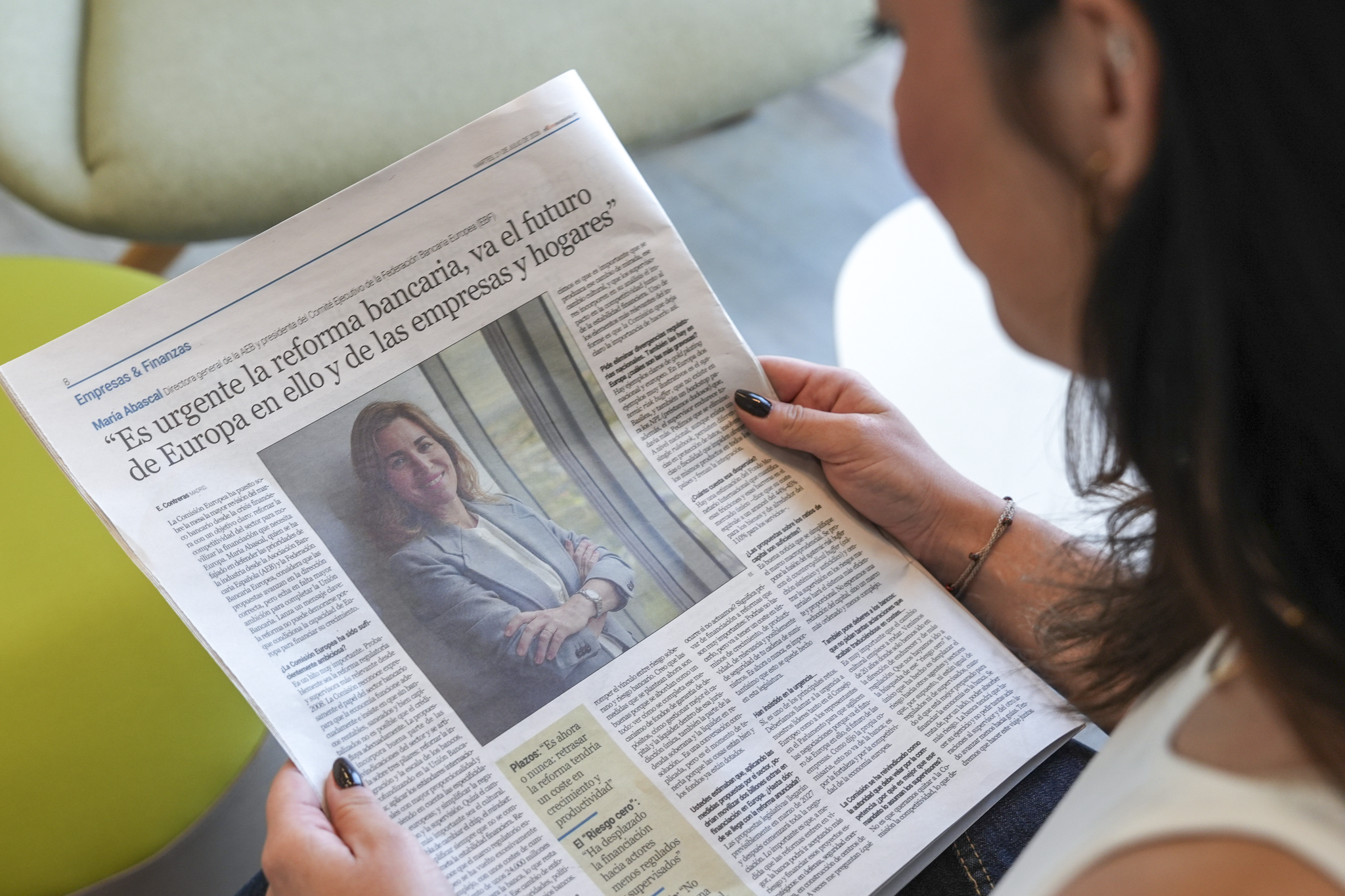
The CEO of the Spanish Banking Association (AEB), María Abascal, welcomes the report on banking sector reform recently announced by the European Commission, although she believes that some of the proposals fall short. This is the case, for example, with the definition of what a future European guarantee fund would look like—a key element for encouraging cross-border mergers. The director general states that the most positive aspect, aside from the fact that these proposals are heading in the right direction, is that this report considers banking to be part of Europe’s strategic autonomy.
What is the AEB’s assessment of the European Commission’s banking reform report?
We certainly welcome this report from the European Commission. It is the most ambitious proposal for reforming the regulatory and supervisory framework since 2008, and it is a step in the right direction.
What is the key point of the reform?
It may well be the analysis and the proposals. But there is no doubt that the measures aimed at deepening integration and enabling European banks to achieve greater scale are sound. The proposed measures to simplify both regulation and supervision are also sound.
And in what ways have they fallen short?
It is not entirely clear exactly what will be done with this single European deposit guarantee fund. There is talk that the 2015 proposal will be scrapped.
Why might a European deposit insurance system be key to mergers?
It is a fundamental element. If we want to further integrate the European banking system, we must instill confidence in the authorities of those countries where the bank’s parent company is not located—only its subsidiaries—so that they understand that if something happens, they will not be affected by a financial stability issue, and so that they realize they will not have to bear the burden solely at the national level.
But, in the end, tackling fragmentation through mergers ends up being a political problem, doesn’t it? As we’re seeing in the cases of Unicredit (Italy) and Commerzbank (Germany).
Well, the commissioner has said—and the report notes—that we should avoid political interference by member states in these cross-border operations. I think there is a widespread belief that we want to have major European banks, and the only way to achieve that is to move forward with this banking union.
Another key point is that financial institutions will maintain their solvency even as regulations are simplified.
I would like to clarify that we in the industry are not asking for a reduction in capital requirements. What we are asking for is to eliminate overlaps and, above all, to stabilize the framework and avoid continuing the current trend of steadily increasing capital requirements. We want to harness the full potential of the banking sector for these strategic projects. We’re talking about strategic autonomy. One of the positive aspects of this report is that it considers the banking sector to be part of strategic autonomy, because without a profitable, strong, and competitive European banking sector, we have no financial autonomy.
And given the tight deadlines we’re working with, will we make it in time? If you look at market capitalization, the top European bank is Santander, which ranks 16th—far behind the leader, the U.S.-based JP Morgan.
Europe has very strong, very efficient banks, and what we need to do is make it easier for them to compete on a level playing field. It’s true that valuations have improved in recent years thanks to strong results, but overall I believe we have an overly complex regulatory and supervisory framework. The goal is to streamline and simplify things as much as possible, and I also believe that everyone has a role to play here. This includes politicians, because while this set of measures is excellent, there will eventually be a legislative proposal, and politicians will have to approve it. We’ll see how much of what the commission proposes they actually approve.
Do you expect there to be a social backlash to these changes? The 2008 crisis left social scars, and on top of that, the banks had to be bailed out with public funds.
The banking sector has been part of the solution during some—let’s say—challenging situations that have arisen recently, such as the pandemic, the war in Ukraine, and extreme weather events. The banking sector has always been there, and I believe that in that sense, it has done its part; it is sound, well-capitalized, and is helping the economy continue to function normally. Therefore, I believe this reform is good for the economy, for businesses, and for households. This isn’t just for the banking sector; it’s for the region as a whole. We need this to maintain our economic relevance and to preserve our social model in Europe. Europe has a growth problem; we need this reform, and this reform is good for everyone.
What about the deadlines and dates for submission?
The Commission has indicated that it will present its legislative package in the first quarter of 2027—which we understand will likely be in March—with the goal of having it approved and finalized by the end of 2027. Okay. Okay. We think this is a really tight or unrealistic timeline by European negotiation standards. The message we want to convey is that we have no time to waste.
Do you think it will go even further back in time?
What I believe is that we need to appeal to the sense of responsibility of everyone who now has to approve these reforms so that we truly don’t start getting bogged down. We need to look beyond the immediate and have a vision for Europe and what Europe needs right now.