Home / Latest News / You may be interested in / Interviews / “Big Tech must be subject to the same regulation as banking for the consumer’s benefit”
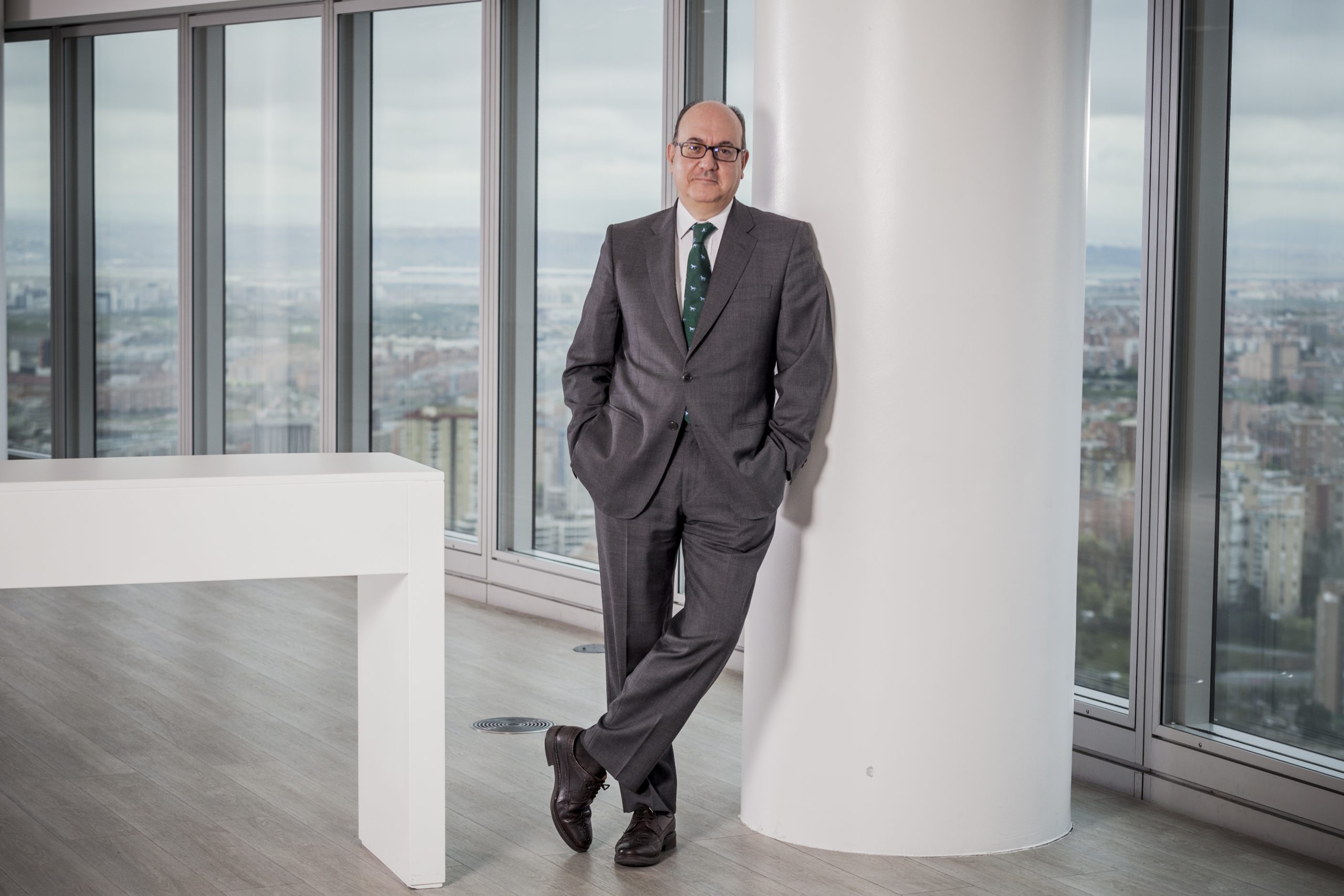
While José María Roldán receives us at the headquarters of the Spanish Banking Association, the IMF Managing Director is speaking in London about the reputation of the financial industry. Christine Lagarde specifically refers to the premiere of Mary Poppins Returns. “Why is the banker the villain of the film?” she asks. We pose the same question to the AEB president: “Why does your sector have such a deplorable image?”
We are in Torre Espacio, on a completely glass-enclosed floor. Madrid extends at our feet, but not as far as the eye can see. At a certain point, the city stops, as if hitting an invisible wall. “The commercial attaché of the British embassy, which is upstairs,” Roldán tells us, “shows it to all his visitors. Look at the madness that is Spain, he tells them: suddenly you go from having houses to having nothing. In London you don’t see that. There all land is developable and you have to justify why you cannot build. Here it’s the opposite: land is not developable and you have to justify why you build. That’s why there is so little. That’s why it costs so much. That’s why the city stops.”
But we will return to housing prices later. Now we want to know why the banker is the villain of the film. Lagarde maintains that one need not look too far back to find the origin of the frustration: the Great Recession. Roldán agrees in part. “The sector’s reputation must be seen in the context of the reproaches suffered by many central institutions in the West: political parties, parliaments, capitalism… We are part of the establishment and, as such, we are questioned. It is, moreover, a widespread phenomenon: it occurs in most developed countries, not only in Spain. But,” and here he disagrees with Lagarde, “its roots go beyond 2008. Napoleon already said that bankers lack patriotism and decency and that their only objective is profit. The crisis has not helped, but in Australia they have not suffered any and yet their institutions are not better valued. And in Spain the problems were basically with the savings banks. The banks that are members of the AEB have not received a single euro.”
Well, Pablo Echenique, the Secretary of Organization of Podemos, wants to impose a solidarity surcharge on you to recover the aid.
Tell me where that money they have given us is and we will return it. Those rescued were the savings banks, and not all of them, it is fair to say.
And why were they rescued? Even some right-wing economists were in favor of letting them fall, so as not to encourage moral hazard.
It would not have been the savings banks that fell, but the savers. That has not happened anywhere. Not even the current resolution mechanism touches deposits. And the liquidation of Popular has not cost the taxpayer a single euro.
Some believe that the opposite mistake was made there and that, to avoid the bailout, an institution experiencing temporary difficulties was sacrificed.
That is saying a lot. The problems were deeper. There was a real risk of contagion and we were fortunate that the situation was resolved overnight and, the next morning, customers operated with complete normality. Once again, the intervention was carried out with depositors in mind. Neither then nor before have the aid been directed at managers or shareholders.
Will the bailout money be recovered?
It has only been achieved in the United States, but it was a very quick and very forceful action. In 2008, as soon as the crisis broke out, the Treasury Secretary gathered the banks and forced them to increase capital, whether they wanted to or not. It is, in any case, a very different society. The adjustments are merciless: those of banking and those of other sectors. Entire industries are allowed to fall, even if they drag a city down with them, as we have seen with automobiles and Detroit. Recovery is also very quick, but with a social cost that I do not know if Europeans would be willing to pay. In Japan they are very clear that they would not. Supervisors do not mind using public funds to shore up their institutions, because they are very aware of the devastating impact of a financial crisis.
It seems that you are giving up the battle for image.
Not at all, but we need to explain better that a healthy economy is not possible without healthy banking. We want Spaniards to understand the role we play in financing companies and families. Our mortgages are among the cheapest in the eurozone and loans to SMEs are at the level of Germany, despite the fact that the markets charge them less for money.
A certain left still calls for public banking.
It is a political decision: if the Government deems it appropriate, it is within its rights. That said, it would make sense if there were needs that the private sector did not address, and that is not the case. Furthermore, the experiences are not very positive. The most recent one is quite recent. The Official Credit Institute uses, as you know, banks to allocate its funds, but during the crisis it began to finance SMEs directly, without intermediaries, for fear that their excessive caution could harm solvent companies. The line had to be cut immediately, because the non-performing loan ratio was enormous. A state operator does not have to answer to private shareholders and therefore lacks incentives to carry out adequate risk management. The market will have its flaws, but it is ruthless with those who do poorly.
You are also accused of being ruthless. The courts consider that your mortgages contained abusive clauses.
There have been foreclosures, but in a much smaller number than the 500,000 refinancings that have been carried out. What would have happened in other European countries if unemployment had reached 27%? In some you can be evicted from your home without going to court.
Where?
In the Netherlands, for example.
The outcry against banking has been considerable. Ada Colau is mayor of Barcelona thanks to her campaign at the head of the Platform for People Affected by Mortgages.
Some cases have done us enormous damage. We probably reacted late, but we reacted. We have developed a code of good practices and, now, families at risk are identified and offered alternatives, such as payment in kind, social housing, etc.
Many people also complain that fees have skyrocketed.
We come from a time when margins allowed us to subsidize some services. I never liked it, because it benefited the customer who demanded the most services at the expense of others, but even if we wanted to, we could not. Our core business, which consists of borrowing short-term and lending long-term, is no longer as profitable. In theory, rates are always higher long-term than short-term and, in fact, they are distributed along a curve that steepens as we move into the future. But today short-term rates are negative and the curve is almost flat.
Should the price of money be raised?
It would be an element of hygiene. It would prevent investors from taking excessive risks and fueling bubbles. But I am afraid we will still have to wait.
You complain that your margins are narrow, but then the profits of Santander, BBVA or la Caixa come out and they earn billions.
Profitability is not measured by absolute results, but by relating them to the resources employed. When this is done, the margin obtained is 1%, much lower than that of most sectors.
So, fees are going to continue to rise.
We are moving toward a world in which each customer will be charged based on what they demand. In any case, what studies say is that in Spain there is a range of free services far superior to that of other countries.
Given the picture you paint, you will be against raising taxes.
Banking already contributes to the Treasury what corresponds to it. In Spain it pays for the profits from Spain, in Mexico for those from Mexico, in Brazil for those from Brazil… What is absurd is to demand that it pay taxes here for what it has earned worldwide. I understand that there is a problem with the pension system, but its solution cannot rest exclusively on us. And we must also be careful when taxing mobile bases, such as stock market investment, because we run the risk of them moving to other markets.
Speaking of flights, don’t you think that Spain has not known how to maneuver to keep part of the financial business that Brexit is going to free up?
We have a strong sector, but in commercial banking, not investment banking, which is predominant in London. My impression is that the big beneficiaries of the UK’s exit from the EU, if it happens, are going to be New York or Singapore. I always say that I go to Frankfurt [ECB headquarters] to talk about supervision; to Brussels [Commission headquarters], to talk about regulation, and to London, to take the pulse of the market. Will Paris or Berlin give it to me when Brexit is consummated? We shall see.
The capitalization of banks is not very high. Is there not a risk that someone will take advantage to launch a takeover bid?
The world of the digital revolution favors economies of scale. To be competitive, you need to make large investments and those fixed costs are easier to spread the larger your customer base. Size is therefore key and it is logical that there will be mergers and acquisitions.
Inside or outside Spain?
If in 10 years we do not see any cross-border operation, the banking union will have failed. Some consider that the banking union consists of cutting the link between sovereign debt and banking, so that the fall of the latter does not drag down the entire country. But I think it goes further, that it is about building a European financial sector, just as there is a European automobile or services market. The big difference between the United States and the EU is that there they have only four or five major banks and here we exceed twenty. Pan-European institutions are needed.
And in that battle, will the Spanish be the predator or the prey?
Here we have gone from 45 institutions to 13. Our banking has done its homework and, when you compare valuations, it is better than in the rest of Europe. I believe we are going to be bidders, rather than targets.
And will the Germans, French and Italians allow themselves to be taken over?
The world of national champions is part of the past.
And what about Amazon, Alibaba and Google? Maybe they are the ones who end up eating the banks.
It is undeniable that the internet has broken down barriers between sectors and countries, and we are delighted to compete, but on equal terms. If big tech wants to engage in finance, they will have to be subject to identical regulation and supervision. PSD2 [the second payment services directive] requires banks to open our customers’ accounts to third parties. Well, fine, I understand, it is about facilitating transactions. But can we access their customers’ data? No. That lack of symmetry is incomprehensible. Because we are not talking about defenseless SMEs, but about giants that are natural monopolies.
But at the moment neither Amazon nor Google are taking deposits.
Nor do they need to. In an environment of negative rates, liquidity abounds.
Isn’t your discourse somewhat against progress? People are delighted with big tech.
We are the first to defend innovation, but only as long as it is not based on unprotecting consumers. To prevent a crisis like the one we have just overcome from happening again, we have built walls and, inside, we scrutinize everything, but outside we let everyone do as they please. It is not coherent.
The Great Recession originated in the so-called shadow banking, that is, in everything that is precisely outside the system.
Exactly, and since then it has only grown. Why? Because institutions are now required to have triple the capital, so there are triple the reasons to go underground.
Could the catastrophe be repeated?
Shadow banking is larger and no one has a clear map of what is in there: venture capital and hedge funds, REITs, business angels, crowdfunding, private equity… There is, however, an important difference from 2007: the structured investment vehicles (SIVs) that issued mortgage derivatives operated with liquidity lines that conventional banks had provided them and, when the SIVs collapsed, the losses went into the banks’ balance sheets. Now that linkage does not exist.
Another similarity with the prelude to the crisis is the rise in housing prices.
The situation is nothing like it. In 2007 we far exceeded one million mortgages granted; now we are around 300,000. The weight of construction in GDP reached 10%; now it is 5%.
You don’t see any bubble, then.
Not at all. What there are are specific land supply problems in cities like Barcelona or Madrid. [And he points to the invisible wall against which the city stops].
We have a rarefied political situation. Pedro Sánchez has just called elections because he lacked a majority to pass the budget, but nothing indicates that the next Congress will be less fragmented.
It is something we are going to have to learn to live with. Many countries with an equally fragmented parliamentary spectrum manage to make their institutions work and the economy grow. I don’t think it’s that difficult.
What reforms do you consider essential?
More than specific initiatives, I would emphasize that the important thing is not to make mistakes. We have enormous external debt, which makes us very vulnerable. So far we have financed it without problems, but this requires working not to lose the confidence of investors.
And what else?
Is that not enough?
José María Roldán, Chairman of the Spanish Banking Association