Home / Latest News / You may be interested in / Interviews / Alejandra Kindelán: “We have 20 supervisors and regulators without anyone having a complete overview”
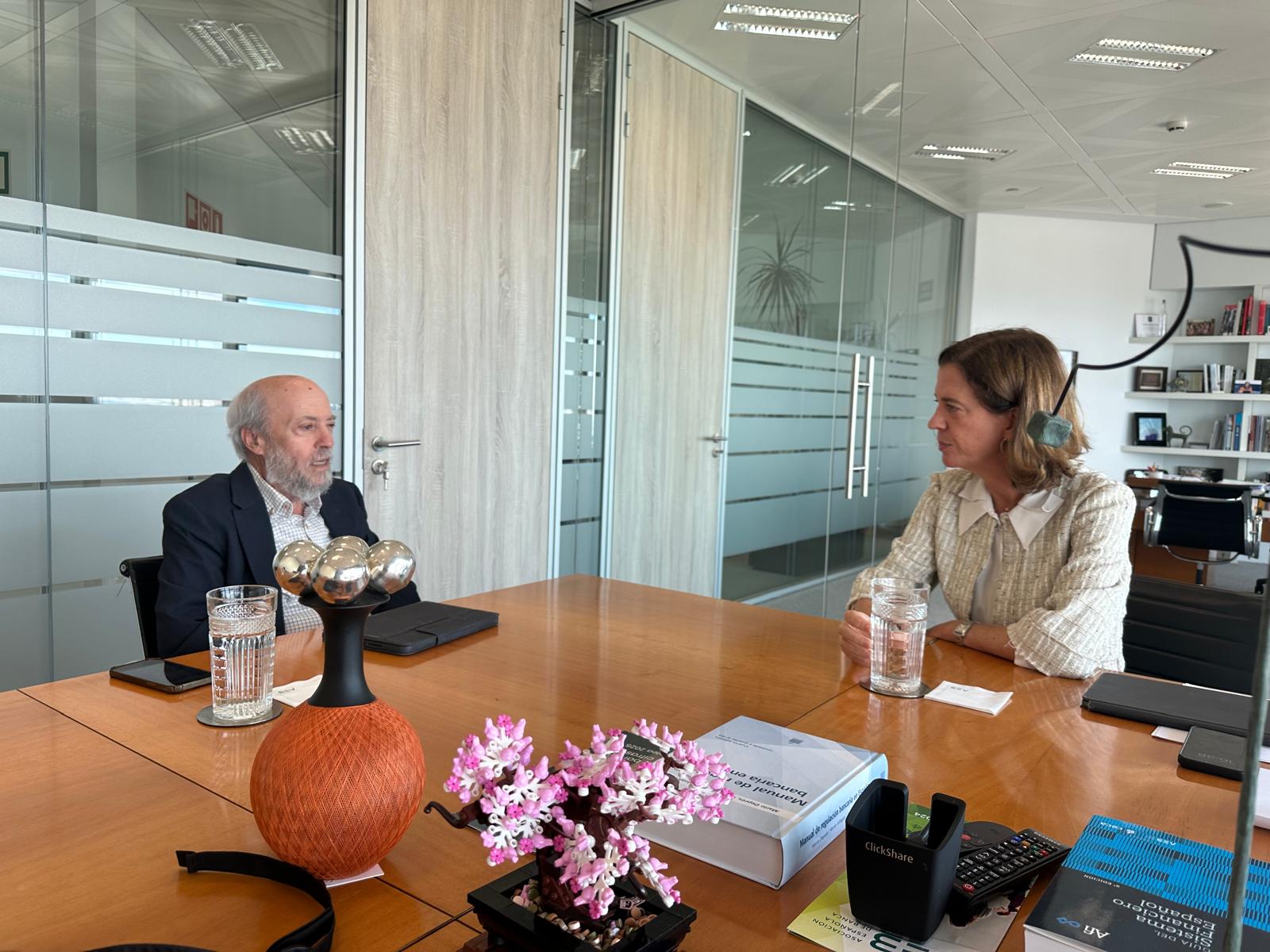
Interview in the *Economistas* magazine published by the Madrid Association of Economists (CEMAD)
Alejandra Kindelán (Caracas) has been the president of the Spanish Banking Association since 2022, having previously served as the head of the Research Department, Public Policy, and Institutional Relations at Banco Santander. During her years leading the organization, her defense of the banking sector’s interests has focused on demonstrating the fundamental role banks play in the smooth functioning of the economy. She has called for a reduction in the obstacles she believes hinder this role and has worked to bring the sector closer to citizens by showcasing its social sensitivity.
The financial sector has been pointing out that it suffers from excessive regulation and numerous supervisors, and is calling for a simplification of rules that would lead to lower capital requirements…
The important thing here is the general context—the current state of Europe and its needs. Europe has been and remains in a growth crisis. It has struggled to grow for the last few years, decades even, and I believe the time has come to change that. The good news is that the diagnosis has been made. The Draghi and Letta reports provide us with a clear roadmap for integration: on one hand, a stronger internal market and further integration, and on the other, a focus on growth and competitiveness.
The regulatory framework for our sector was created, reinforced, and radically transformed after the previous crisis, with a heavy focus on eliminating or reducing the risk of crises and removing the costs of crises for taxpayers. Now we find ourselves at a time when the urgent needs are growth and competition. To achieve this, we need a financial sector that is willing, prepared, and incentivized to offer its full firepower to the real economy.
It is true that the regulatory framework we mentioned is very complex because Europe is complex by definition. Furthermore, a framework has been created with a first level coming from Brussels; a next level that develops more detailed rules in Paris at the European Banking Authority; and then you have the supervisor in Frankfurt. You have those three levels, not to mention the bank resolution system, which is yet another regulatory entity. In total, as a sector, we have more than 20 regulators and supervisors, without forgetting the national authorities. Each one adds its own layers and regulatory requirements without anyone having a complete overview. That is what we are asking for.
The other issue is that capital is used as the fundamental instrument for imposing requirements on the sector. We would like to address this ‘capital-centrism’.
What is happening is that entities need more and more capital to do the same thing, and it is noted that this translates into a potential cut in credit reaching society.
That is correct. The European Banking Federation’s report on simplification includes an independent study showing that in the last four years, capital requirements for European banks have increased by €100 billion. Part of the capital requirement stems from the transposition of Basel, which represents €400 billion for the sector. But above that Level 1, you have those arising from Level 2—the rules, every technical detail, every regulation… many of which also impact capital. Then you have the supervisor’s requirements. They might review models and request a capital increase for specific issues. And then you have the macroprudential buffers, which are decisions made by the national macroprudential authority. All of this adds another €270 billion in capital. This has not stopped rising, and the problem is that there is no complete overview of it all.
Of course, all of this has a direct effect on credit. The study quantifies the effect on the volume of credit that could be released, using a ratio ranging between ten (according to French calculations) and fifteen times (according to ECB methodology assumptions). This means those requirements can translate into between €2.7 trillion and €4.1 trillion less in credit at a time when it is said that €1.2 trillion is needed for investments and when banks will play an essential role.
Is this not in contradiction with the fact that almost all European banks are carrying out aggressive share buyback programs to amortize capital?
I would say they are two different things. It is very important to maintain the sector’s investor appeal. For years, banks have been recovering profitability levels, but stock market valuations were well below market expectations; the value of banks was below book value. That is also an anomaly. What we want is for banks to be valued at least at their book value. This is an anomaly that is important to correct, and it began to be corrected when a consistent and solid shareholder distribution policy was established. Aggressive programs? Is a 50% payout aggressive? That is roughly where it stands. To reward shareholders, you have two instruments: dividends and buybacks, and the supervisor values both equally. You can distribute dividends or perform share buybacks. In the case of share buybacks, the supervisor requires a formal request and must grant authorization, making them even more prudent; if they saw any problem, such as a threat to the entity’s solvency, they would not authorize it.
In recent years, with the return to normal interest rates, the results of entities have reached levels clearly above the cost of capital. Is this a reasonable level, or can entities be expected to have higher profitability in the near future?
It is reasonable to have a return above the cost of capital. What was abnormal was what we experienced in the years leading up to this. That was a concern for both the supervisor and the regulator. I believe it is an achievement that we have these profitability levels, because we know that profitability is the first line of defense in the sector, and without solid profitability, we will not have the capacity to lend in the future. Achieving these levels has been very important. It is reasonable to have profitability levels above the cost of capital.
I do not know what will happen with interest rates because interest rates are a matter of monetary policy, and what they wanted to do in Europe—and have done well—is control inflation. Bank profitability is well-established in very diversified business models, not only geographically but also by business line. It is also based on very good efficiency ratios, which is very important because, out of every hundred earned, Spanish banks spend less than forty, while German banks spend nearly eighty on average. Spanish banking will have good profitability ratios in the future.
The ECB seems determined to launch the digital euro so that companies and citizens can have a current account within the Eurosystem. Do you think it is necessary to launch it, or would it be enough to ensure that the Spanish Bizum and its European counterparts are interconnected to cover that service?
The digital euro project is an important project for the Eurosystem in which Spanish banking is collaborating. We have participated in all the working groups and are responding to all the consultations currently being prepared. We also share the objective of gaining autonomy in payments. This is also important. Currently, payments are dominated by American payment solutions—cards—and the search for strategic autonomy in payments is relevant, just as it is in other fields. We have private solutions that work very well. We know this in Spain. Bizum has nearly 29 million users and started in 2016. Its use is common across all generations. It has permeated Spanish society deeply. It is incredibly easy to use with all the security provided by the banking framework, because it was born from the banks and operates within the banks’ perimeter. Furthermore, it is free for the consumer and is now expanding its use cases. What are we working on now? Interoperability—the interconnection of our Bizum with others. Bizum already has an alliance with Andorra, Italy, and Portugal. New countries are joining, such as Poland, the Nordics, and Greece, and more are in talks. At the same time, there is another initiative encompassing the digital payment systems of France, Germany, the Netherlands, and Belgium. I think this way of moving forward with payments and gaining autonomy from foreign solutions is good.
Some voices consider that the figure the ECB is handling as the maximum that citizens can hold in that account is low and are requesting it be raised. Could that pose a problem for bank deposits?
It is true that the limits are still under discussion. At the Ecofin meeting a few weeks ago, they discussed this and created a system to begin assessing where that limit should be set. Where will the limit be? I don’t know, but if the idea of the digital euro is to be a digital form of cash, it turns out that, on average, European citizens hold €45 in cash, according to recent studies. It is true that there are areas where more cash is used (countries, rural areas…), that is surely the average, but between €50 and much higher figures…
If the idea is for it to be a digital form of cash, the digital euro can serve as a complement. We were talking earlier about digital payments and private options. The digital euro can complement these in some way with what we call offline payments; when we are not connected to the internet, there could be a digital euro wallet so I can transfer my digital euros from my mobile to yours with the anonymity that some request. We will have to explain why the digital euro is different from a current account.
I would now like to talk a bit about the sector’s reputation, which has its lights and shadows. Individually, according to surveys conducted by all entities, users are not dissatisfied with the entity or entities they work with, but when asked about the sector as a whole, that positive rating drops substantially. It is clear that there do not seem to be serious problems in this regard at the moment, but do you fear that if the economy were to take a turn for the worse again, as happened in the past, the banks would once again be blamed for everything that happens?
We have the obligation and the task of continuing to explain to society, in good times and bad, the importance of having a solid, profitable, and efficient banking sector with social conscience or social sensitivity, and I believe we are demonstrating this. I was very pleased that the upgrade of the Kingdom of Spain’s rating noted that the solidity of the banking sector is one of the elements behind that rating improvement. I think it is something we should be proud of and that we must value; we must continue to insist on the necessity and importance of solid banking. We also saw in the past, when that was not the case, the problems it brought us. We must continue to share and explain that social sensitivity we have talked about so much, because I believe we have many things we can talk about. We meet approximately every six months with the Minister of Economy, and there we discuss what we are doing in rural areas, with the elderly, and with people with disabilities. We can point to the €1.864 billion that the banks and foundations within the AEB’s scope allocate to social action. Those of the CECA also have spectacular figures. If we aggregate everything, we reach very high figures of social contribution, beyond our day-to-day work of providing credit to families and businesses. We must continue to insist on this so that society understands it.
A few years ago, one of the major fears banks had was the entry of new players who were not subject to the same regulations. For some time now, people have stopped talking about it. Are they no longer a danger?
I do not like to talk about fears or dangers. What I believe is that our banking sector is very well prepared, that Spanish banks are strong and competitive, and we like competition. We compete well; we have entered other markets where we have been very competitive and continue to be so. And it is a banking sector that, besides having that financial strength and solidity, is at the technological forefront—it always has been. The example of Bizum we discussed earlier is another sign of how we are at the forefront, staying ahead. That is why we are well-equipped to compete with those new entrants. It is also important, as we have always said, that there be a level playing field: same activity, same rules, same supervision.
Finally, both the authorities and the banking sector in general have been pointing out for several years the need for citizens to increase their financial education and, in fact, both the administration and the sector have many initiatives. There is no doubt that progress is being made, but there is still a long way to go…
The starting point is not good. 40% of Spanish citizens do not know what inflation is and have not had financial or economic training during their years of education, because there are no mandatory hours of education in primary, secondary, or high school. Unless you study a degree related to economics or business administration, for example, the concept of inflation might never be introduced to you. That is why I believe it is very important that we try to make some hours mandatory—basic financial knowledge that will stay with you your whole life. Ultimately, throughout your life, you will have to make decisions where you need to apply this knowledge; otherwise, you will not be able to manage your savings well. The first modules of the program we run from the AEB with banks in high schools are dedicated to managing a budget—knowing that a budget exists: income and expenses, prioritizing expenses, and then having a savings buffer. The next step is how you manage those savings.
We are at a time when we want to develop European capital markets and we want those savings not to be only in deposits, but to be diversified—and diversified wisely with a return that, at the very least, beats inflation. But of course, if you don’t know what inflation is, it will be difficult to manage all that. Therefore, I believe this basic knowledge should be mandatory. I think we all need to work toward that. I believe there is now a clear awareness at all levels that this is important. The Bank of Spain has a very clear intention here. The Governor has spoken about it extensively, and I believe the leadership of the Bank of Spain is important, along with the rest of the institutions, the CNMV as well, and of course, the Ministry and the entire sector. In the sector, we have been working on this for a long time. All entities have financial education programs. As an association, we have a very good portal that brings together all these resources from the banks—not only AEB, but also CECA and UNACC—which includes everything from podcasts for entrepreneurs to stories for children. I think the goal must be to have some mandatory hours to ensure that all citizens have these basic concepts.
Interview conducted by Salvador Arancibia