Home / Latest News / You may be interested in / Interviews / Alejandra Kindelán “Europe exports 300 billion in savings that we must retain here”
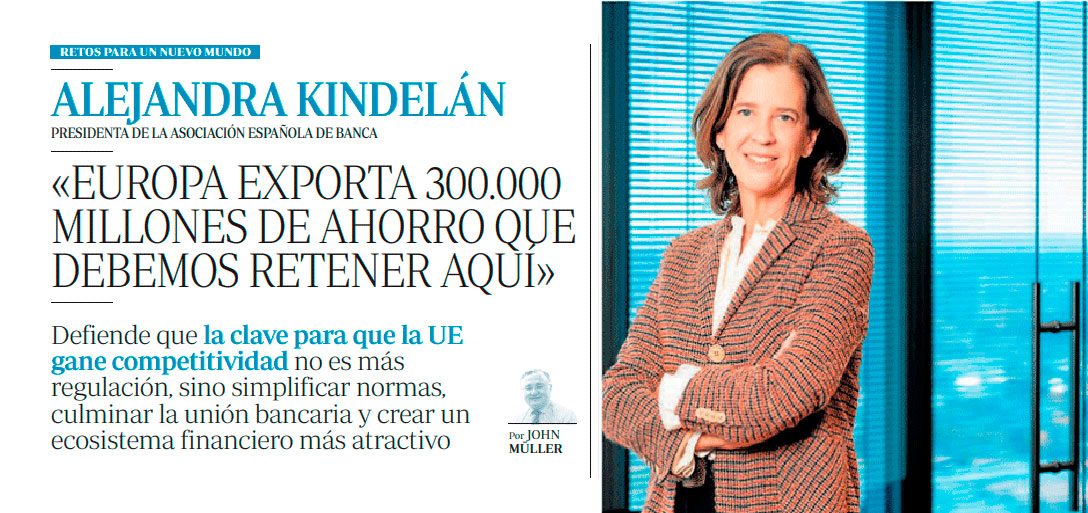
Alejandra Kindelán (Madrid, 1971) chairs the Spanish Banking Association (AEB) and knows European economic architecture like few others. An economist and political scientist, she has spent decades analyzing regulatory reforms, financial cycles, and savings behavior. Kindelán maintains that European banking has a crucial role today. Not only because it finances three-quarters of the continent’s investment, but because it is called upon to be the bridge that converts citizens’ savings into projects capable of raising productivity and strengthening European strategic autonomy.
What role should banking assume to drive European investment and productivity?
Banking is at the center of Europe’s economic and social modernization. The figures are eloquent: three-quarters of European investment financing comes from the banking sector. And investment needs are enormous: Mario Draghi estimates at 1.2 trillion euros annually what Europe will have to allocate to infrastructure, energy, telecommunications, defense, or digitalization. Our commitment is to continue leading this process. And not only through credit: also by improving operational interconnection. A very concrete example is Bizum. We are working to make it interoperable with other European systems so that a citizen can pay with their mobile phone in any EU country with the same ease with which they do so in Spain today.
Has European regulation become too complex for a sector that needs agility?
The current regulatory framework was born from the financial crisis fifteen years ago and has been built in successive layers. The result is an extremely complex system: in the last four years, some 1,755 regulations have been generated, more than one per day. In total, some 95,000 pages with which banks, regulators, and supervisors work daily. It is not that we want less regulation. Regulation is essential for stability. What we are asking for is a simplification process: detecting duplications, ordering priorities, and conducting better impact analyses. The current complexity diverts many resources toward compliance and reduces capacity for what is fundamental, which is financing the real economy.
Europe often boasts of “regulatory quality.” Is the problem quality or quantity?
Regulation is like medicine: the dose matters. An adequate dose strengthens; if you overdo it, it generates adverse effects. In Europe, the dose has exceeded what is reasonable and, moreover, has become too technical and fragmented. Between Brussels, the European Banking Authority, and the supervisor, regulations have multiplied and many overlap. It is not about deregulating. It is about rationalizing, simplifying, and avoiding automatically responding to each new risk with more capital.
Europe is losing competitiveness against the United States and Asia. Is the incomplete integration of the market the main cause?
It is one of the most determining causes. The IMF has calculated that eliminating internal barriers in goods in Europe would be like removing a 44% tariff, and in services, a 100% one. That gives an idea of the economic cost of our fragmentation. The other major cause is regulatory complexity. European construction has advanced layer upon layer, without an overall vision. If we want to compete in a world where other regions are advancing rapidly, we need a more integrated single market and simpler, more coherent regulation.
Europe exports savings. How can we ensure that this money stays at home and finances our growth?
We export around 300 billion euros in savings each year. It is a contradiction: we have gigantic investment needs, but part of European savings goes to finance projects outside. Retaining it requires creating an attractive financial ecosystem for citizens: simple and competitive products, greater regulatory stability, tax incentives that encourage investment in Europe and, above all, financial education. When citizens understand risks and opportunities well, they can make better decisions and channel their savings toward European projects, thus strengthening growth and strategic autonomy.
What geopolitical risk concerns the European financial system most?
I describe it as a “tense calm.” We live in a world with strong commercial, technological, and geostrategic tensions, especially between the United States and China. Europe must find its position on this new board. We face growing global economic fragmentation, and that can harm our growth if we do not react. The positive thing is that the diagnoses have already been made. Reports such as those by Draghi and Letta agree that the priority is to gain scale: more single market, more financial integration, and more capacity to finance our own transformations.
Artificial Intelligence is already transforming the sector. What balance do you see between risk and opportunity?
Banking is investing very intensively in Artificial Intelligence. And it makes sense: it will allow us to process information better and faster, personalize the relationship with customers, anticipate needs, and improve risk analysis. But we must proceed with caution. AI requires a solid ethical foundation, good governance, and regulatory clarity. Spanish banking has proven to be very resilient in recent years; now it is about using AI as a lever for that strength, never as a risk factor.
What explains the strength of Spanish banking compared to European banking?
We come from a very deep restructuring process after the previous crisis. That has strengthened capital, solvency, and efficiency. Today Spanish banking is, literally, on the European podium. Our return on equity (ROE) is around 15%, compared to a European average close to 10%. And we are very efficient: out of every 100 euros received, we spend 43. The European average is around 54 and some entities exceed 70%. Added to this is high solvency, consistent with our business model, and good results in stress tests. That strength is fundamental to be able to finance companies and families even in adverse scenarios.
The United States finances innovation via capital markets. Should Europe aspire to a similar model?
Europe needs a more diverse financial ecosystem. Banking cannot do everything, nor is it desirable that it should. We need deeper capital markets: more venture capital, more private equity, more bond and equity issuances. Banking is key in this ecosystem for two reasons: it channels citizens’ savings toward those markets and accompanies companies in their leap to them. The broader the range of financing, the more opportunities there will be for companies and savers.
How does Spanish banking differ from European banking?
It is a model very close to the ground. The weight of credit in balance sheets is ten points higher than the European average, and we also have ten points more financing via deposits. That means less dependence on wholesale markets and more direct relationship with families and businesses. In addition, we have some 78,000 physical contact points throughout the country, the second densest network in Europe. And our major entities have grown internationally through autonomous subsidiaries very connected to local productive fabrics. All of this contributes to the sector’s resilience.
Without a complete banking union, can there be a truly integrated financial market?
No. We have made great progress with single supervision and resolution, but a European Deposit Guarantee Fund is missing. It is essential for two reasons. First, because all EU deposits should be equally protected. Second, because banks must be valued for their real strength, not for their nationality. As long as the last line of defense remains national, banks will be perceived as Spanish, Italian, or German, not as European.
Cybersecurity is a critical front. What is the main challenge today?
It is an enormous challenge. We invest a great deal, but technology is not enough: cooperation and citizen awareness are needed. I always say that in the digital environment you must be as concerned as in real life. If you do not hand over your keys to a stranger, you should not hand over your passwords either. In Spain we have advanced with measures such as blocking fraudulent calls from operators or lists of suspicious numbers. Success requires shared responsibility among banking, administrations, security forces, telecoms, and technology platforms.
Has the special tax on banking in Spain come to stay?
Spain already starts from taxation higher than the average: 30% in Corporate Tax compared to the general 25%, plus specific taxes such as Legal Document Tax or the tax on deposits, and contributions to the Deposit Guarantee Fund. In total, some 12,000 or 13,000 million annually. This includes a temporary levy extended for three more years, as a tax, which we have appealed and which harms our sector’s ability to compete against other countries that do not have it. Those 1,500 million annually could support tens of billions in credit.
If you had to choose a single lever to strengthen the European economy in the next decade, what would it be?
If you allow me two: the integration of the common market and regulatory simplification. But if I can only keep one, I choose simplification, thinking of banking and all productive sectors. It is the one that can have the fastest effects: reducing complexity, gaining predictability, and freeing up financing capacity. Deep financial integration takes longer, but Europe has already identified that path. What is missing is ambition and urgency. Because the cost of not acting is clear: losing savings, losing investment, and losing weight in the world.
Interview conducted by John Müller