Home / Latest News / You may be interested in / Articles / Banking, a vector of growth
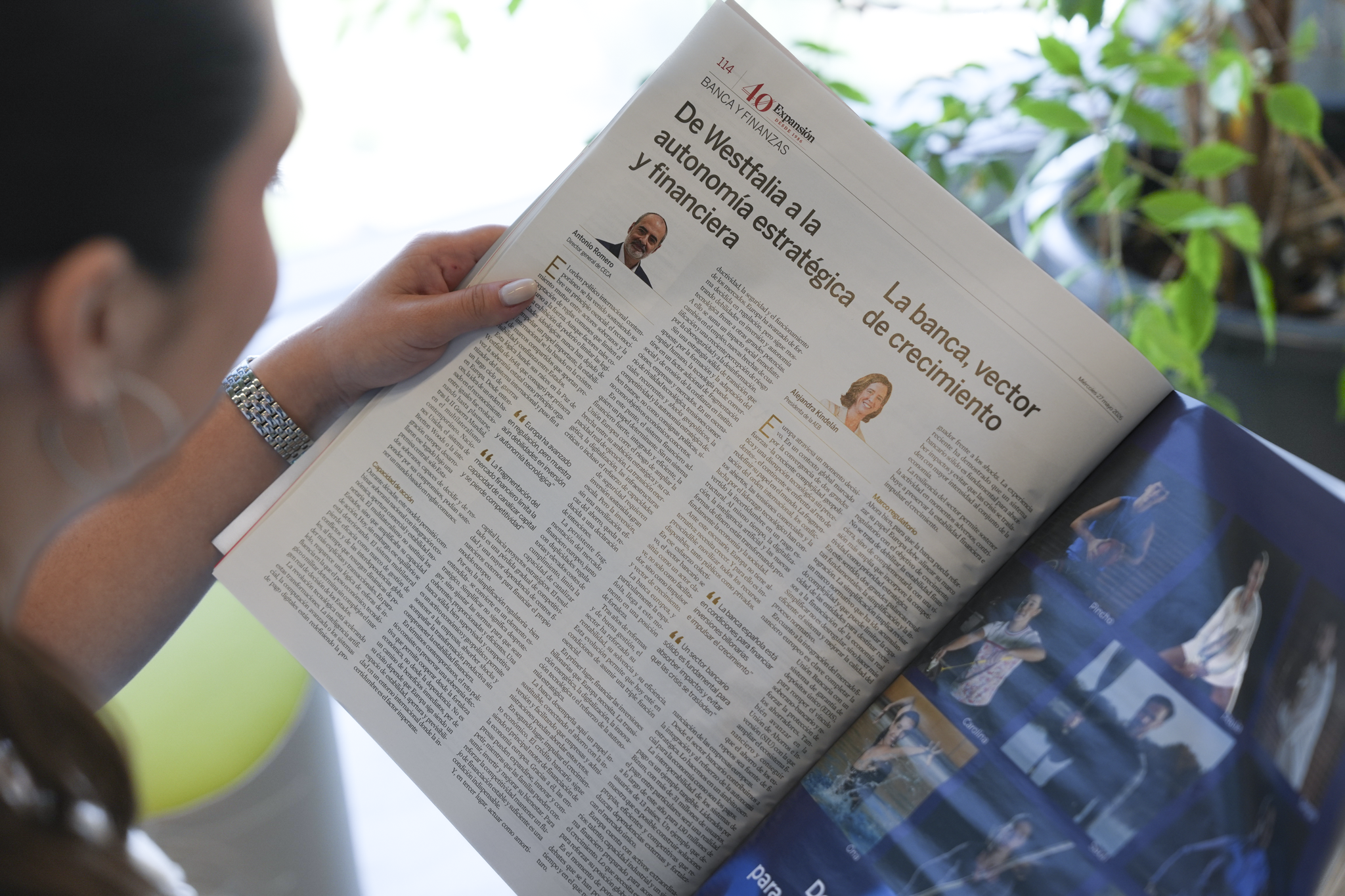
Europe is at a turning point. In a global context marked by the convergence of two major forces – increasing geopolitical complexity and unprecedented technological disruption – the continent faces the challenge of redefining its role in the world. The fragmentation of the international order, open conflicts, trade tensions and the struggle for technological leadership have made uncertainty a structural feature. At the same time, digitalization, artificial intelligence and new forms of money are profoundly transforming the economy and society.
Faced with this scenario, Europe has no alternative: it needs to grow. To achieve this, it is essential to mobilize all available resources, both public and private. In this collective effort, the banking sector is a key player, not only as a facilitator, but also as a driver and vector of growth.
European banks, and particularly Spanish banks, are now in a position of strength.
After years of reform and good management, the sector has strengthened its profitability, solvency and efficiency. As a result of these developments, it is now in a position to assume a triple essential function.
First of all, to finance the trillion-dollar investments that Europe needs. Energy transition, digitalization, technological innovation or the reinforcement of strategic autonomy.
Banking plays an irreplaceable role here, connecting savings with investment and making it easier for companies and administrations to address these challenges.
Secondly, boosting economic growth. Bank credit remains the main driver of financing for the European economy. Thanks to it, companies can expand, innovate and compete, while households can consume, invest and improve their well-being. Maintaining a stable and sufficient flow of financing is a prerequisite for strengthening competitiveness.
And, third, to act as a shock absorber. Recent experience has shown that a sound banking system is essential for absorbing shocks and preventing crises from being transmitted with greater intensity to the economy as a whole.
The resilience of the sector allows it to sustain activity in adverse times, helps to preserve financial stability and boost growth.
Regulatory framework
However, in order for banking to strengthen its role, Europe must align its regulatory framework with the objective of growth. It is not a question of weakening financial stability, but of complementing it with a broader vision that incorporates competitiveness as a strategic priority.
In this regard, two major levers are essential: simplification and integration. Simplification implies revising a regulatory framework that has been accumulating complexity and that may limit the ability of institutions to allocate resources to financing the real economy. Simplification does not mean deregulation, but rather making the system more efficient and improving the quality of the regulatory process.
With regard to the integration of the European financial market, it is essential to complete the Banking Union with a single deposit guarantee system (EDIS), in order to break the sovereign-banking link and reinforce the protection of savers. Progress must also be made on the Savings and Investment Union (SIU) to expand the financial ecosystem and ensure that Europeans’ savings become a source of financing for European companies.
From the banking sector, we contribute to the integration and reinforcement of strategic autonomy. We do so in an essential area for the economy such as payments.
The interoperability of payment systems is a tangible example. Led by Bizum, with more than 31 million users, payment between individuals will become a reality this year for 130 million users in 13 countries. An example that demonstrates that it is possible to build own, efficient and competitive solutions that reduce external dependencies and strengthen the single market.
Europe has extraordinary assets: talent, industrial capacity and a financial system ready to support growth. What it needs is ambition to strengthen its global position.
It is time to put on the table debates that have been postponed for too long and in which our future is at stake.
Alejandra Kindelán, president of the Spanish Banking Association.