Home / Latest News / You may be interested in / AEB Informs / Banks: Key to the Post-Pandemic Recovery
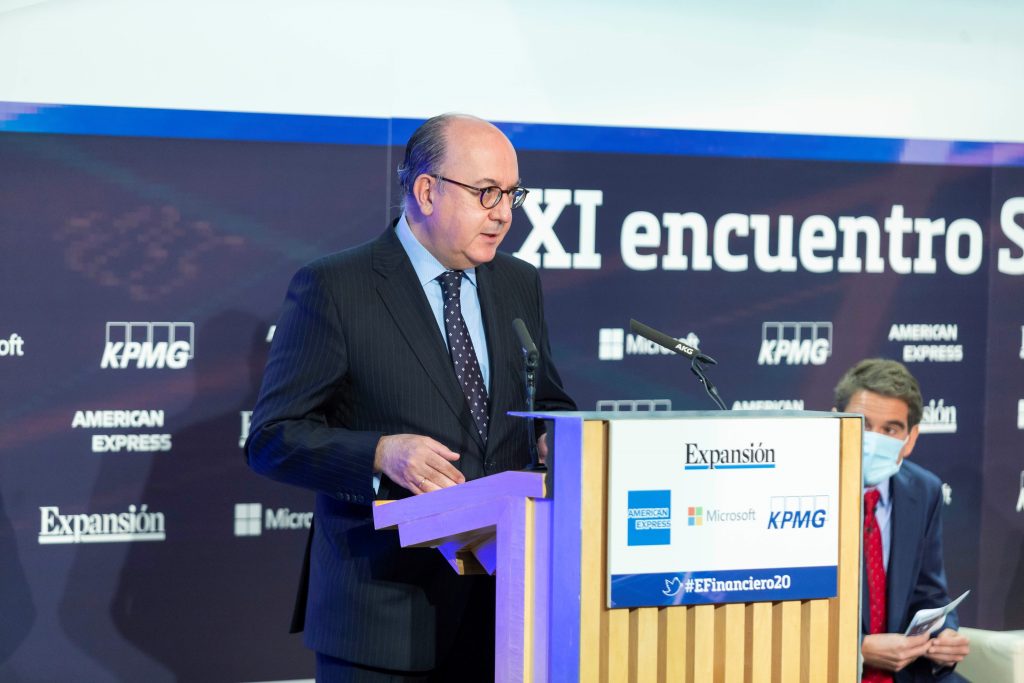
Speech by José María Roldán at the 11th Expansion and KPMG Financial Sector Meeting:
The banking sector, like all other economic agents, is facing an unexpected situation—a health and economic crisis caused by a pandemic that is proving very difficult to overcome. Regarding these circumstances, which we discuss at length but know little about, I would like to present three brief and, I hope, clear ideas during the ten minutes scheduled for this intervention.
The first idea concerns the performance of banks in this new situation, where they have contributed very actively to mitigating the negative effects of the pandemic. Allow me to remind you of some of these contributions. One has been the provision of financial services during the difficult months of lockdown, both through bank branches and digital channels. And they have done so with a significant portion of their staff teleworking, without any technical incidents.
Another important contribution has been maintaining financing channels, with the invaluable collaboration of the ICO and the Public Treasury, for those companies with pressing liquidity problems, which has prevented hundreds of thousands of small and medium-sized enterprises from closing permanently. This public-private partnership allowed us to reach more than half a million companies very quickly, right in the initial moments when lockdown measures reduced the income of many companies to zero and when the need for liquidity was most urgent.
The implementation of sectoral moratoria, as a complement to public ones, has been equally relevant, contributing to easing the financial situation of a large number of families and self-employed workers. As a result of all this, customers trust their banks, and they are right to do so: let us consider what would have happened in the toughest months of lockdown if banks had not been able to come to the aid of their customers, as has happened with other financial operators. To put it bluntly, I have not seen any shadow banking operator come to the rescue of any banking customer when things took a turn for the worse.
And here, as the second idea of my intervention, I want to speak briefly about how shadow banking is operating under the new circumstances. In this new digital world, we observe an increase in competition in all areas, which is partly based on regulatory arbitrage. If you are not a bank, you can perform many quasi-banking financial functions without having to respect the solvency, financial stability, or consumer protection rules to which banks are subject. Let us consider, for example, that for the granting of credit, it is not only that a banking license is not required, but a license granted by a financial supervisor is not required either. Authorities theoretically accept that financial activities generating similar risks should be subject to the same rules and the same supervision. But at every step, they make it clear to us that this principle is currently more of a wish than a reality.
Let’s look, for example, at what has happened in the Treasury Bills market (US Treasury debt), the safest, most liquid, and deepest in the world, where there is concern about the role that shadow banking is playing. Last March, the federal monetary authorities of the United States (the Fed), in a response as rapid and forceful as it was essential, addressed the problems of lack of liquidity and the exorbitant increase in spreads by coming to the rescue of unregulated entities such as Hedge Funds. Allow me to add that part of the problem is generated because regulators have deliberately excluded banks from these markets: Basel III prevents them from having played a stabilizing role during the episodes in March. What a paradox!
It seems clear that if we are not able to level that playing field, we are not only going to have competition problems in the medium term, but we will already be entering very dangerous territory regarding the preservation of financial stability or crisis management. Innovation in the technological field, as desired as it is essential, cannot occur at the expense of financial stability or consumer protection.
And I move now to the third idea, concerning the reconstruction of our economy and the role of the banking sector in this process. As you know, the post-COVID world is taking shape around digital and sustainable themes. When it comes to rebuilding the economy, it makes no sense to recreate the economy of the past; instead, we must bet on the future around those two great axes: the digital revolution and the green revolution.
Precisely, the European Union has based its economic recovery plan on those two pillars, the digital and the ecological, through support for private investment. We are talking about 750 billion euros. For 2021 and 2022 alone, Spain is entitled to 44 billion. The key to success will lie in using those funds wisely, with the greatest possible granularity, achieving the greatest multiplier effect in terms of employment and increased long-term competitiveness.
What can the banking sector contribute? To begin with, its commitment to digital transformation and sustainability. I have already mentioned how during the lockdown we were able to accelerate the use of digital channels for the provision of financial services without a single incident. Regarding the commitment to sustainability, and as was made clear at COP25, we have accelerated efforts, and the Spanish banking sector is already seen, in less than a year, as a leading sector on par with other pioneer banking systems.
Furthermore, few sectors possess the granularity and efficiency to deploy policies more rapidly. And I refer to what has already been said about how we have been able to bring financial relief to 525,000 companies with the ICO guarantee program. We are a guarantee of efficiency and an example of agility throughout Europe.
Banks can also contribute their knowledge of customers. Consider that the commitment to measure and reduce the carbon footprint of our balance sheets requires us to help our asset customers make that journey. Why not play a role in the distribution of European funds that have precisely that objective?
Banking entities also provide objectivity and well-defined criteria in any process, as seen in the ICO program, financing those who need it and are in a position to contribute more in the future. Likewise, we can act as a bridge for those European funds, which may take time to arrive, avoiding bottlenecks or unnecessary delays. And we can provide more complementary funds, thus leveraging the use of those funds and multiplying their positive effect.
In short, in the coming months, we must lay the foundations for a better future. As a sector, we do not seek prominence or recognition, but we do make clear our desire to help, because we know we can do it. Therefore, we reiterate our offer to play a role in the implementation of the European Union’s NextGen plan, as we humbly believe we can assist in the selection of projects, ensuring granularity, effectiveness, and objectivity in the process.