Home / Latest News / Press releases / The National Police reinforces cooperation with public-private entities in the fight against terrorism financing and radicalism.
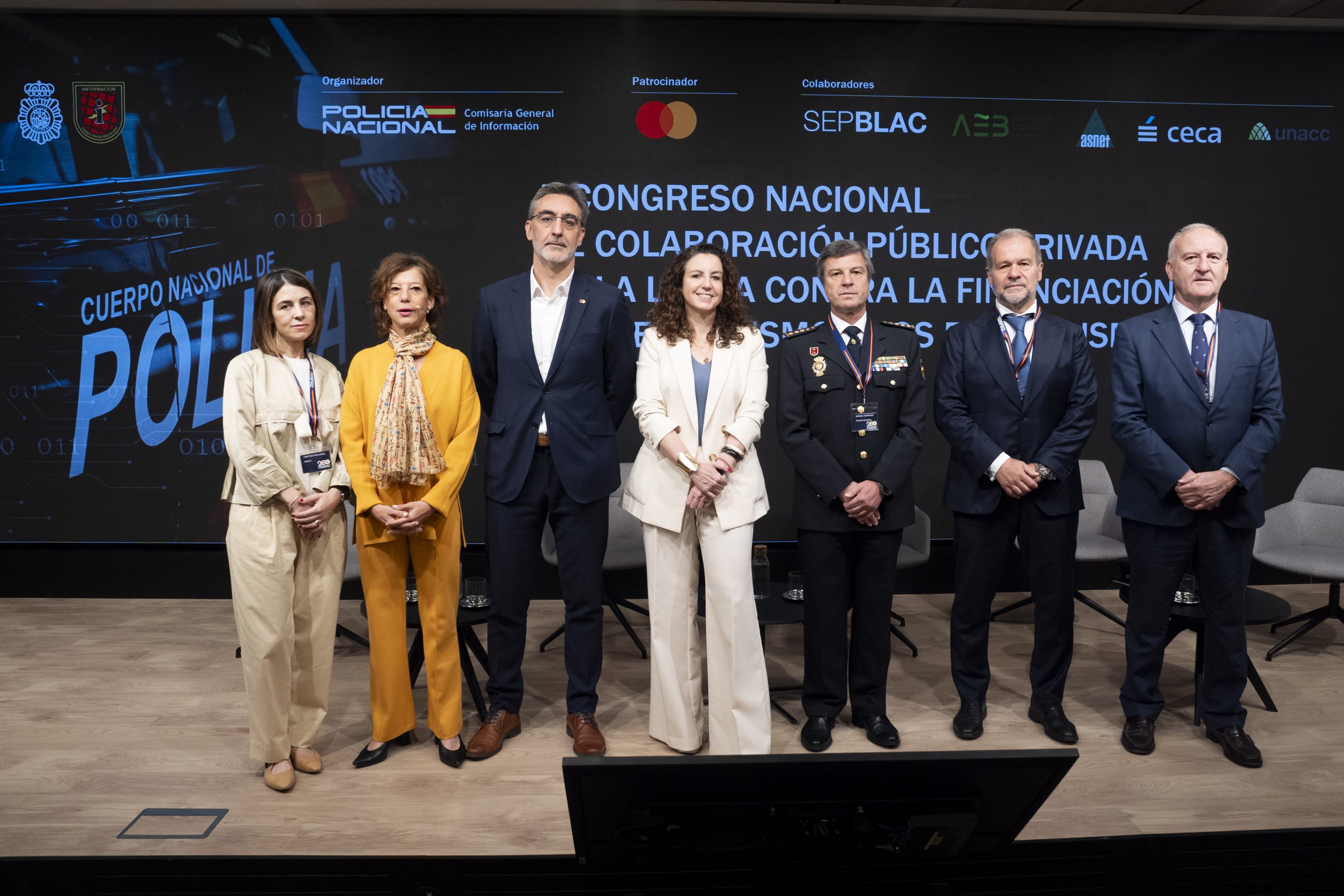
The National Police has organized in Madrid the second edition on “Public-Private Collaboration in the Fight against Terrorism Financing and Radicalism.” The event gathered numerous specialists in the field of prevention, detection, and the fight against terrorist financing. The conference, organized by the General Information Commissariat, was supported by the Executive Service of the Commission for the Prevention of Money Laundering and Monetary Offenses (SEPBLAC), the Spanish Banking Association (AEB), the National Association of Financial Credit Institutions (ASNEF), the association of Savings Banks and Banks created by them (CECA), the National Unit of Credit Cooperatives (UNACC), and Mastercard.
Strengthening ties between the National Police and private entities
This second edition delved into strengthening collaboration between the National Police and obligated entities in the prevention and detection of terrorism financing and illicit radicalism for the successful conclusion of police investigations. To this end, the conference addressed topics in round table format such as “The Prevention of Terrorism Financing from SEPBLAC’s Perspective,” “The Fight against Terrorism Financing from a Police Perspective,” “The Use of Artificial Intelligence for Money Laundering Prevention,” and “Radicalism, Macro-Destabilizing Phenomena, and Counter-Proliferation.” Within this theme, various working groups exist at the national level to establish and strengthen ties with obligated entities in the prevention and detection of terrorism financing and radicalism.
The conference began with a first round table where, at a general level, the importance of public-private collaboration in this fight was highlighted, featuring the intervention of the head of operations of the General Information Commissariat, Manuel Rodríguez, who stated that “Economic investigation is an essential element in the fight against terrorism and radicalism, not only aimed at clarifying financing crimes but also related criminal offenses connected to the activities of organizations. The collaboration of the private sector is indispensable for both preventive activities and the neutralization of the terrorist threat.”
For his part, the director of SEPBLAC, Pedro Comín, emphasized that “In this new congress, we have been able to verify how terrorism financing continues to be a relevant threat in a globalized world that exploits technological innovation, which is transforming our society, for its own benefit; hence, public-private collaboration, of which this congress is a good example, is a fundamental element for us, with the help of financial entities and other obligated parties, to anticipate and prevent this scourge.”
The prevention of terrorism financing
Analysts from Spain’s Financial Intelligence Unit (SEPBLAC) shared their experiences in prevention when preparing their financial intelligence reports with information provided by obligated entities. This topic was moderated by María Peco, senior legal and AML advisor at the Spanish Banking Association (AEB), who noted that “Public-private collaboration, to which financial entities are fully committed, is essential to prevent and combat terrorism financing. In today’s world, marked by interconnection and the immediacy of transactions, knowledge of holdings observed by authorities is vital to ensure effective prevention measures.”
During the congress, those responsible for investigating terrorism financing presented new modalities discovered in investigations to finance terrorism and shared real cases of successfully concluded investigations in a session moderated by the Corporate Director of Risks and Compliance at CECA, Raquel Cabeza Pérez, who highlighted that “the private sector is firmly committed to the fight against terrorism financing, and the information provided by authorities on real cases and warning signs leads to greater effectiveness of the prevention systems implemented by entities.”
Use of Artificial Intelligence for the prevention of terrorism financing
For his part, Alberto López González, Vice President of Innovation Product Management in Cybersecurity at Mastercard, a sponsor of the event, highlighted in his speech that “Money laundering has evolved over the years, moving from being massively used in cash and bank transfers to moving quickly and penetrating any existing payment method, such as cards or cryptocurrencies. To detect and stop such transactions, Mastercard has been working for years with the latest Artificial Intelligence technology to detect all suspicious transactions involved in money laundering movements that pass through our network. Our algorithms are capable of identifying them among the billions of transactions that cross our network annually. Thanks to the knowledge acquired, we are also offering this technology in instant payments, where we have been able to identify and prevent up to 120 million euros in scams and fraud. Instant payments mean being exposed to instant fraud, so the use of AI is essential to prevent it.”
Finally, various specialists from the General Information Commissariat addressed the topic of illicit radicalism, macro-destabilizing phenomena, and counter-proliferation, moderated by the Head of Fraud Prevention and Money Laundering at ASNEF, Juan José Matías González, who noted that: “These types of events are fundamental for the financial sector to acquire the necessary knowledge to achieve greater effectiveness in the fight against this social scourge represented by crimes related to money laundering and terrorism financing and, in turn, to understand the important work carried out by the State Security Forces and Corps in public safety.”
For her part, UNACC representative Cristina Freijanes stated that: “During today’s conference, the importance of public-private collaboration in combating the great threat that terrorism financing poses to our society has been highlighted. Sharing experiences between public institutions and financial entities and staying up-to-date with the latest developments is essential to be effective in this task that belongs to everyone.”