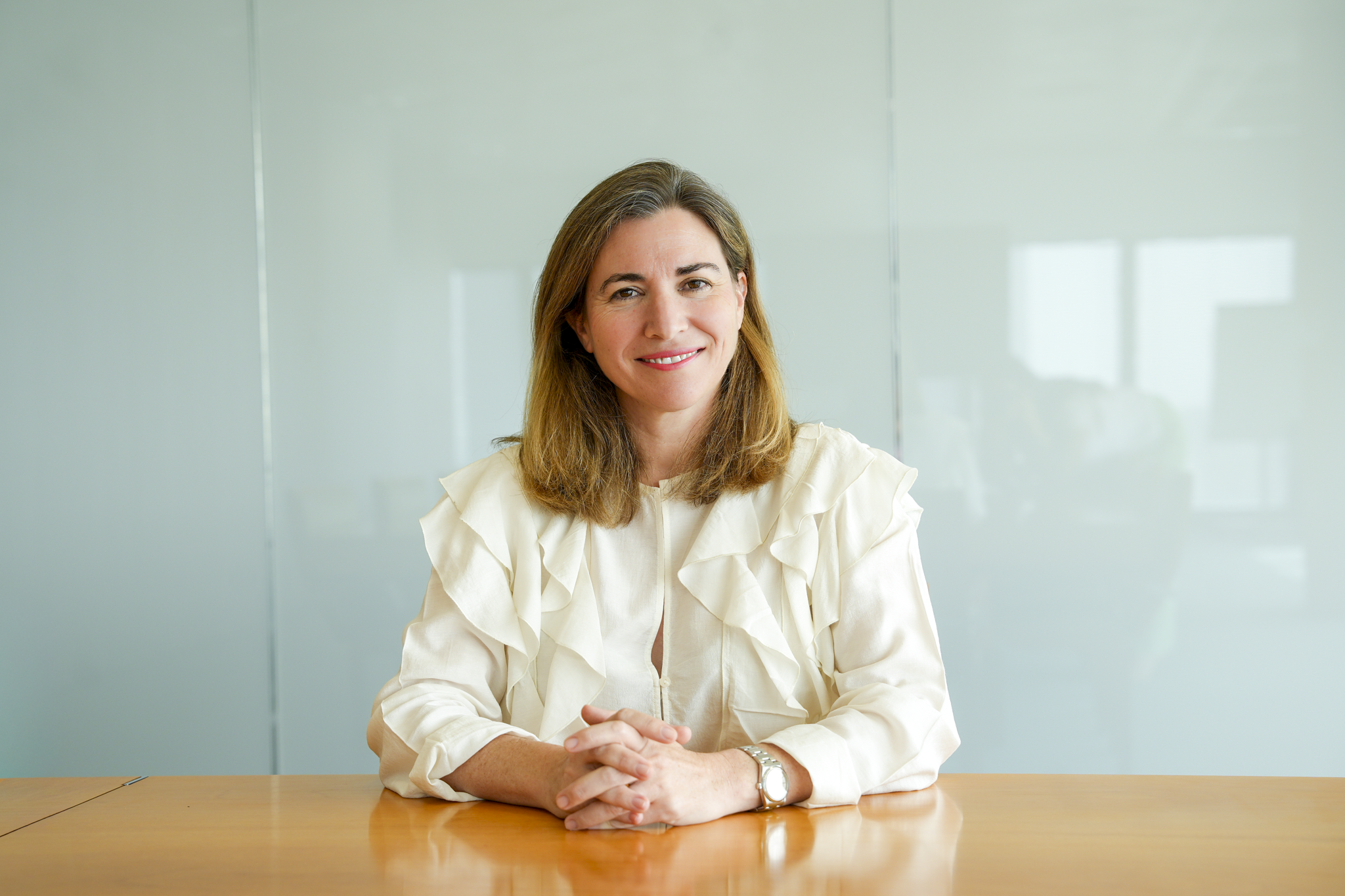
Home / Latest News / You may be interested in / Interviews / Kindelán: “Employment is holding up well; we are still seeing very controlled delinquency rates”
INTERVIEW
In April 2022, Alejandra Kindelán (Caracas, 1971) became the first woman to chair the Spanish Banking Association (AEB), the employers’ association that brings together around 70 Spanish institutions and the in-country branches of foreign banks. This economist took part a few days ago in Málaga in the event “Digital banking towards inclusion”, organised by the AEB Foundation and the Somos Digital Association as part of Financial Education Week, and gave an interview to SUR.
What has the experience of leading AEB been like?
Excellent. It is an experience that is allowing me to better understand and get to know the sector. A very diverse sector, with large and small banks, and where the common thread is that they are very retail-focused banks, very close to their customers, where lending plays a very important role, and where, despite branch closures, we have the third-densest branch network in Europe. In addition, they are innovative banks that created Bizum, a digital instant payment system that is already used by 25 million users.
What are the main pillars of your term as head of AEB?
The association has two important responsibilities. One is related to monitoring the sector’s interests in the face of regulatory changes, and the other has to do with communication and reputation. With regard to the latter objective, we work to ensure that the sector’s mission is understood: to support the progress of families and businesses, to underpin the progress of our economy and society, and to contribute to the social goals we have as a country by supporting older people and addressing the demographic challenge.
After the financial crisis more than a decade ago and after the pandemic, what is the state of the Spanish banking system?
The sector is in a good position in terms of financial strength. We have come through a decade of low or negative interest rates that are now normalising, and that allows us to regain profitability. That recovery in profitability is very important because profitability is the first line of defence for maintaining solvency and continuing to provide credit to support progress for families and businesses. We are the most efficient sector in Europe and we are very well-managed banks. The other strength is social awareness, with support for older people, rural Spain and vulnerable mortgage holders.
Following on from that last point, how has the sector responded to support families facing serious financial difficulties?
There is a great deal of sensitivity to the situation of these families, who are experiencing rising inflation and an interest-rate hiking process led by the Central Bank. This situation is a concern for the sector, and that is why we signed the Code of Good Practice with the Government at the end of last year, anticipating a situation of potential difficulties, offering a series of measures to families within certain income thresholds. Despite the situation, we have not seen a rise in delinquency, which remains very low.
Do you fear that, in the medium and long term, there could be an increase in delinquency and defaults?
What is normal with the economic cycle and with a certain slowdown that we are seeing is that an increase in delinquency could occur, but for now we are not seeing it. Banks are very calm. Employment is holding up well, and the main variable that determines delinquency in banking is employment. With the employment rates we have today, what we are seeing are still very controlled delinquency rates.
How far will the interest-rate rise go?
We do not have our own forecasts. Rates are rising to curb inflation, and what we see from the market consensus is that they may already be reaching their limit.
Could a message of hope not be given to citizens about how long this situation will last?
This depends on the European Central Bank, whose main mission is to control inflation. The truth is that in Spain inflation has fallen so far; however, in Europe there are still certain inflationary pressures, so it is very difficult to know.
Mortgage lending is being affected precisely by the rise in rates. At the same time, demand for housing is becoming increasingly pressing, especially among young people. In this regard, is the banking sector considering any measures to make it easier for young people to access housing?
This is an issue we have analysed in depth. We know that among young people under 35 there are approximately 40% who would be able to pay a mortgage instalment; however, only 3% can pay the 20% down payment required of any homebuyer. That is where we need to find solutions. The banking sector has proposed some ideas such as public guarantees or guarantees that would make it possible to cover or support that down payment, and then young people, with their income, can go on to pay the instalments. This idea worked in the United Kingdom and could work here as well.
How do you assess the guarantee promoted by the Government for young people?
We believe these types of solutions are appropriate. Returning to the topic of mortgages, new mortgage loans being granted this year are still higher than those granted in the same period in 2019, before the pandemic. After the pandemic there was an incredible rebound in lending, possibly due to pent-up demand for home and car purchases, which led to a very strong increase in lending in 2021 and 2022, and now the slowdown is greater because we are coming from exceptionally high levels. But if we compare with 2019 in terms of mortgage lending, we are approximately 25% higher.
Why are mortgages rising, but not the remuneration of savings?
From AEB we should not speak much about the matter because these are commercial terms set by each institution. I can say that the rise in rates has been very rapid in a very short time, and in a year in which there was still a huge excess of liquidity in the market, because for a decade the Central Bank’s policy has been to provide a lot of liquidity, it is difficult to see that there was an incentive to pay for liquidity. That said, we are converging and the gap with Europe is now much smaller, and we are in a process of normalisation.
Regarding the risk of financial exclusion among older people, is that trend being corrected?
A huge effort is being made because we consider it a priority. We are living in an era of digitalisation that intensified with the pandemic. As we emerged from it, we realised that there was a segment of customers—older people—for whom digitalisation was difficult and who preferred in-person service. The sector realised this, corrected course and launched a structured, sector-wide plan to extend counter service hours for older people, to ensure that calls from older people are answered by staff, and we have also adapted apps, websites and ATMs with simpler menus and larger text, which were demands raised by older people’s associations.
The other risk is financial exclusion in rural areas. Has the sector curbed that risk?
There is a significant, ongoing effort. We carried out a diagnosis of the municipalities that had been left without a physical presence of institutions and financial services. From there we segmented them, and in towns with more than 500 inhabitants we have committed, as a sector, to provide at least one point of contact: an ATM, a financial agent or a mobile branch. In the smallest ones, we reached an agreement with Correos so that its postal workers can deliver cash and digital tools with which certain transactions can also be carried out. The latest figure we have is that transactions with Correos have increased by 35%, and not all banks have joined yet.
I understand that digitalisation is one of the main challenges for the banking sector and, in parallel, its cybersecurity.
Digitalisation is a huge opportunity. Digitalisation is inclusion; that is, it makes citizens’ lives easier. It is also true that we have to look after those who may not have the skills, or do not want to, or cannot go digital. Hence initiatives such as delivering courses called “Easy and safe banking” to give users tools to operate digitally and do so securely.
How do you see the situation at Unicaja Banco after the latest changes?
I cannot comment because it is not a member bank of ours and I do not have information.
How do you assess the country’s current political situation?
Political changes are what they are, and we cannot and do not need to comment. We will always work with whichever Government is in office, as we always have. We also have a relationship with the Government that allows us to tell them what we do not like, such as the bank tax, for example. What we do ask for is stability and support for the competitiveness of our economy.
Do you fear there could be new taxes on the banking sector if the current Government is re-elected?
We hope not. We have appealed the current tax because it is counterproductive. It is a tax that has a negative economic impact because taking €3 billion in profit away from the banking sector is €3 billion of potential capital and, therefore, credit, which would have a potential impact of €50 billion in credit and would mean 250,000 fewer mortgages. That is not what the country needs right now. In addition, we do not agree with the two premises on which this tax is based. One is that it is a tax on extraordinary profits, and we say that what was extraordinary was the decade of zero or negative interest rates we have had, and now we are normalising interest rates. The sector’s profitability is also normalising, and those profits the sector has today will ultimately pay taxes. A recent study tells us that the sector is paying 51% in taxes on its profits. 51% is the highest rate in Europe, and if we also include the new levy, we will be ten percentage points above other European countries. It is a very high tax burden. In addition, those sector profits will also pay a dividend to shareholders, who are 5.5 million people, a large proportion of them families and retail shareholders who rely on dividends as a supplement to their income. The other argument used to justify the bank tax is the bank bailout. Well, neither a bailout nor of the banks. In the end, depositors of certain institutions that were not banks, incidentally, were helped—institutions that were politicised, had clear management problems and that are no longer here today (a reference to the savings banks). Those institutions were also supported by the banking sector and by the former healthy savings banks.
Interview conducted by Antonio M. Romero