Home / Latest News / You may be interested in / Interviews / “The Spanish banking system pays the most taxes in the eurozone”

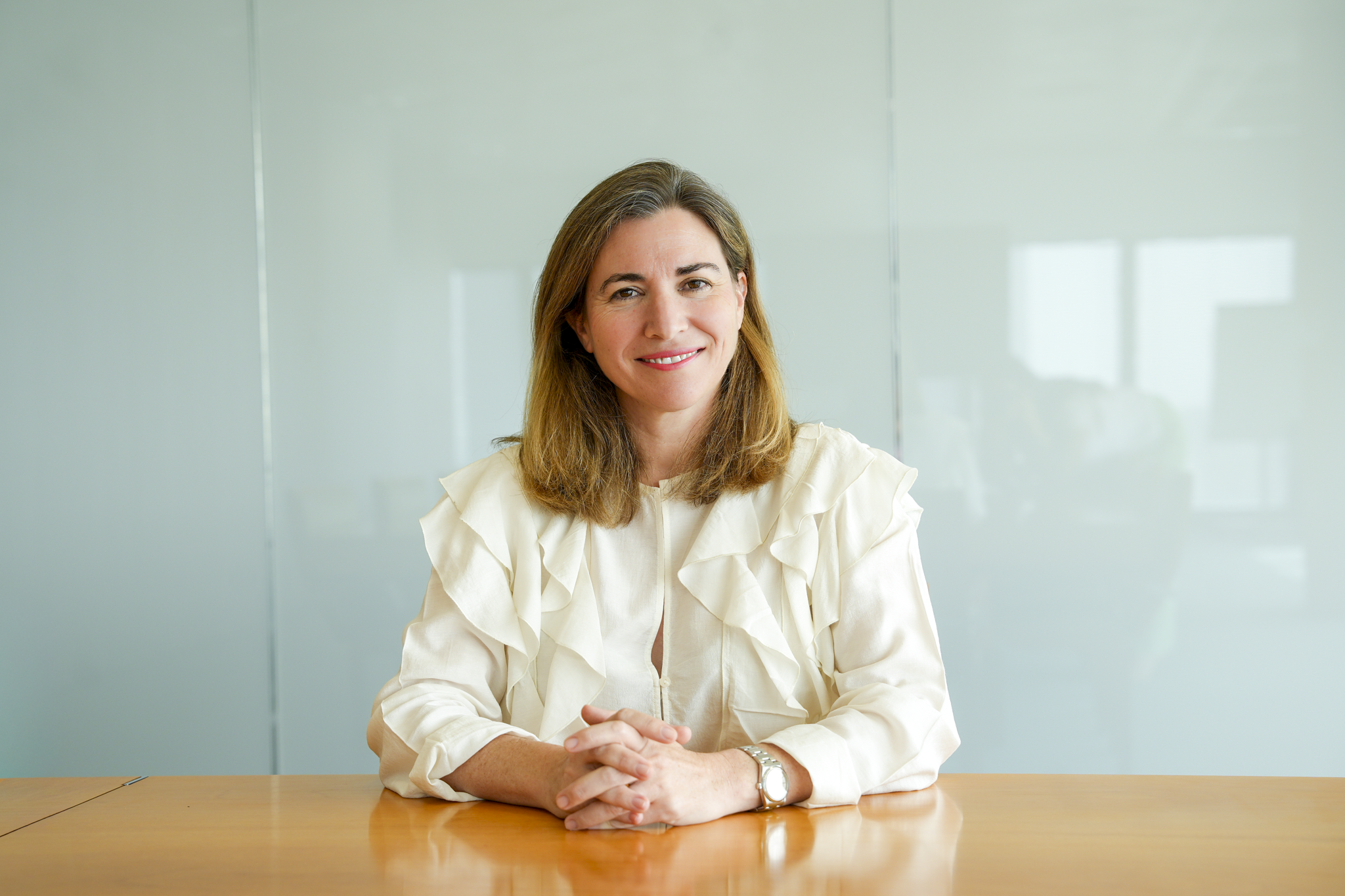
In April 2022, economist Alejandra Kindelán Oteyza took over the presidency of the Spanish Banking Association (AEB) and the AEB Foundation, following a long professional career closely linked to the banking sector.
The current president of the AEB holds a degree in Economics and Political Science from Wellesley College in Massachusetts and has completed the General Management Program (PDG) at IESE in Madrid and the banking program at INSEAD.
Her professional experience includes serving as a consultant for the World Bank, an international economy analyst at Banco Central Hispano (later merged with Santander), and head of the Research and Public Policy Department at Grupo Santander. She has chaired the Economic and Monetary Affairs Committee of the European Banking Federation and was a member of the Regulatory Committee of the Institute of International Finance (IIF); executive vice-president of the Business Advisory Council to the OECD, and a member of the Institute of Economic Studies, the Board of Trustees of the Financial Studies Foundation, and the Observatory of the School of Industrial Organization.
In this interview, she discusses the state of our banking system and its performance in a unique situation for the sector, as well as the extent to which financial institutions are meeting the new and traditional needs of their clients.
As you know, the Financial Education plan of the Bank of Spain, the CNMV, and the Ministry of Economic Affairs is focused this year on inclusive finance. The AEB has precisely launched its Financial Inclusion Observatory. Who is your primary target audience?
I would say the entire population, but with special attention to those who face the most difficulties. The observatory has three main lines of action: improving personalized service for the elderly and providing information about it; training those who wish to operate digitally through workshops and digital skills courses; and extending services in rural Spain.
In the chapter on improving in-person service, we have extended teller hours; those who call by phone, after identification, are assisted by people; and app and website menus are being simplified, with font sizes being increased.
And we are fully committed to ensuring that those who want to learn how to use their devices for daily transactions can do so. Our commitment is that no one is left behind, and that whoever wants and is able to has the necessary knowledge and tools.
Financial education is a priority for the AEB and its foundation. In collaboration with other associations and the entire sector, we have launched the Financial and Digital Classroom, a web training platform to improve the financial knowledge and digital skills of the entire population. In 2022, it received the award granted by the Government, the Bank of Spain, and the CNMV.
One can find written and audiovisual resources for children, teenagers, entrepreneurs, investors… structured by theme and by group.
Speaking of inclusion and specifically regarding young people, the latest PISA report shows that 15% of students do not reach the basic level of financial competence, a significant percentage of the young population. Do you believe that this fact, combined with less personal contact for banking clients due to digitalization, could increase litigation?
This must be a priority for everyone: providing training so that informed and responsible decisions are made. It would be highly desirable for financial education to be included in the school curriculum. In any case, as I have pointed out, it is fundamental for the entities and for the AEB itself.
I believe what we must do is redouble our efforts, as is currently being done, at all educational stages. That is what the sector is doing.
The AEB and its member banks have brought financial education to approximately 249,000 students through physical and digital workshops and seminars organized in 2022.
The data from the last year represents an increase in training hours and reflects this commitment.
With more than fifty active initiatives, finance training promoted by the banking sector exceeded 1.8 million hours in the last fiscal year.
This educational impact on society was made possible thanks to more than 1,500 bank employees who dedicated a total of 4,200 hours to this voluntary teaching work.
In the digital sphere, banks have succeeded in raising financial education awareness among more than 10.3 million unique users, 27% more than the previous year.
In this sense, how do you think banking entities are handling the promotion of greater and better use of digital banking by the elderly population and those with less internet access?
Banking is a sector that puts people at the center. Out of conviction, it is making an effort in two areas: promoting innovation and digitalization to facilitate day-to-day operations, and improving in-person service for the elderly.
We are convinced that digitalization is inclusion:
That said, we also know there are clients who prefer or need in-person service, and we provide it through 17,600 branches. It is the third densest network per million inhabitants in the European Union. Furthermore, we strive for the digital empowerment of these groups so that whoever wants to can do so.
Particularly relevant in this regard is the effort the sector has made to bring banking services to rural Spain. A year ago, the associations signed the ‘Roadmap to reinforce financial inclusion in rural areas’. The goal is to ensure in-person access to banking services and cover 100% of the territory. We identified municipalities with fewer than 500 inhabitants without these services, and 243 municipalities were in this situation.
One year later, following public tenders, collaboration agreements, and the willingness of the entities, the report we presented recently shows that 93% of municipalities with more than 500 inhabitants will have that access point through ATMs, mobile branches, offices, or financial agents. These are nearly 200,000 people who, within a year, will have access to in-person services.
Something that has been suspended for now is the creation of the Independent Administrative Authority for the Protection of Financial Clients. Do you believe the creation of this body is necessary?
We already stated our position at the time. We understand that this European directive had to be transposed, but since we saw the first texts—which have been amended in some important aspects—we said we did not consider it necessary to create a new body. We believed a better option, in line with what has been done in other countries, would be to improve or adjust certain aspects of what already exists at the Bank of Spain, the CNMV, and the Directorate General of Insurance. We do not see major problems in these claims services… what exists can always be improved.
The only similar experience is the one in the United Kingdom, which was designed for 300 workers with the goal of reducing litigation; once launched, both the structure and the number of claims multiplied.
It is true that during the parliamentary process some aspects were refined, such as the funding formula with a fee of 250 euros per claim to be paid by the banks regardless of who was right. A funding structure that, undoubtedly, created a terrible incentive. This and other aspects were no longer in the final text that lapsed due to the election call, and that is where we stand today.
According to recent news, the Spanish banking sector has appreciated by more than 24% on the stock market this year and is at its highest levels since March. This is a better trend than that of European banks. To what do you attribute this better performance of Spanish banking compared to European banking?
I like to say that Spanish banks are among the best in Europe and the world.
These are the days for presenting results, and Spanish banks have demonstrated strength and sensitivity. This is evident in the commitments we discussed to improve service for the elderly, inclusion in rural Spain, the promotion of digital training and Financial Education, and assistance for mortgage holders with problems, as outlined in the Code of Good Practices (CBP) agreed upon with the government.
Furthermore, there is a high degree of competition. I would like to point out a series of factors that are the pillars of that strength: business model, solvency, liquidity, non-performing loan ratios, and retail commercial banking—geographically diversified in the case of the main entities—based on the provision of financial services and the intermediation of savings, investment, and consumption for families and companies.
A very significant part of their balance sheet is represented by retail deposits used to finance the credit portfolio for families (mainly for home acquisition) and companies (largely SMEs). More than 50% of the balance sheet is represented by loans and deposits to families and non-financial corporations, approximately 10 percentage points more than the SSM (Single Supervisory Mechanism) average.
It is, therefore, a very diversified investment/financing structure that provides great stability to the balance sheet and high recurrence to the income statement.
Regarding solvency, the recent publication of the results of the stress test exercise conducted by the EBA (European Banking Authority) has shown that Spanish banks are among the most resilient and have the capacity to solvently face a potential worsening of the global economy, even in an adverse scenario.
As for liquidity, Spanish banks have a comfortable liquidity position. All ratios (LCR, NSFR, Loans to deposits) are above the eurozone average.
And non-performing loans continue at low levels; the NPL ratio is at its lowest since the 2008 crisis.
As a conclusion to all of the above, the profitability level of Spanish banks is almost double the European average. Profitability is essential for sustainability.
I like to say that profitability is the first line of defense… and it is good news for the economy and for the country.
Some of the main banking entities in Spain have expressed opposition to extending the bank tax. What do you think would be the effects of a possible extension of this tax for the banking sector?
The sector, entity by entity, and also the trade associations, have appealed the tax. In the case of the AEB (Spanish Banking Association), we appealed the Ministerial Order.
It is argued based on ‘windfall profits’ that are not such; we are coming from a decade at ‘0’ or negative, and a rescue that was not such—banks contributed up to 26 billion euros to the deposit guarantee fund and SAREB.
From the very beginning, we have warned of the counterproductive effects on the economy and, very especially, on credit. We have calculated that it would have an impact on credit of 50 billion euros, with its subsequent effects on GDP and employment.
Under current geostrategic circumstances and given the forecast of an economic slowdown, an extension measure does not seem most appropriate.
Banks pay more taxes, with a 30% Corporate Tax rate, in addition to other specific taxes. The Spanish banking system pays the most in the eurozone. It reduces competitiveness compared to European partners. A report prepared by PwC indicates that the major banks contributed 6.439 billion euros in taxes in 2021. This represents 51% of pre-tax profits.
Therefore, banks are the sector that contributes the most to the “welfare state” within the EU.
Having made these reflections, I believe what must be avoided above all is the tone of finger-pointing toward the sector used to justify this tax.
Within the General Council of Economists, we have a specialized body, EAF, which brings together more than 80% of the financial advisory firms registered with the CNMV. What role does the sector assign to these firms: that of collaborating agents or as competition?
Competition is always positive because it forces improvement, and this is positive for clients. They also benefit from greater transparency and the expansion of product distribution networks. Furthermore, these firms and the banks have a common goal: to improve the financial education of clients. They must make informed decisions, which is undoubtedly very positive for reinforcing financial stability.