Home / Latest News / You may be interested in / Interviews / “There is no banking sector in Europe that pays more taxes than the Spanish one”
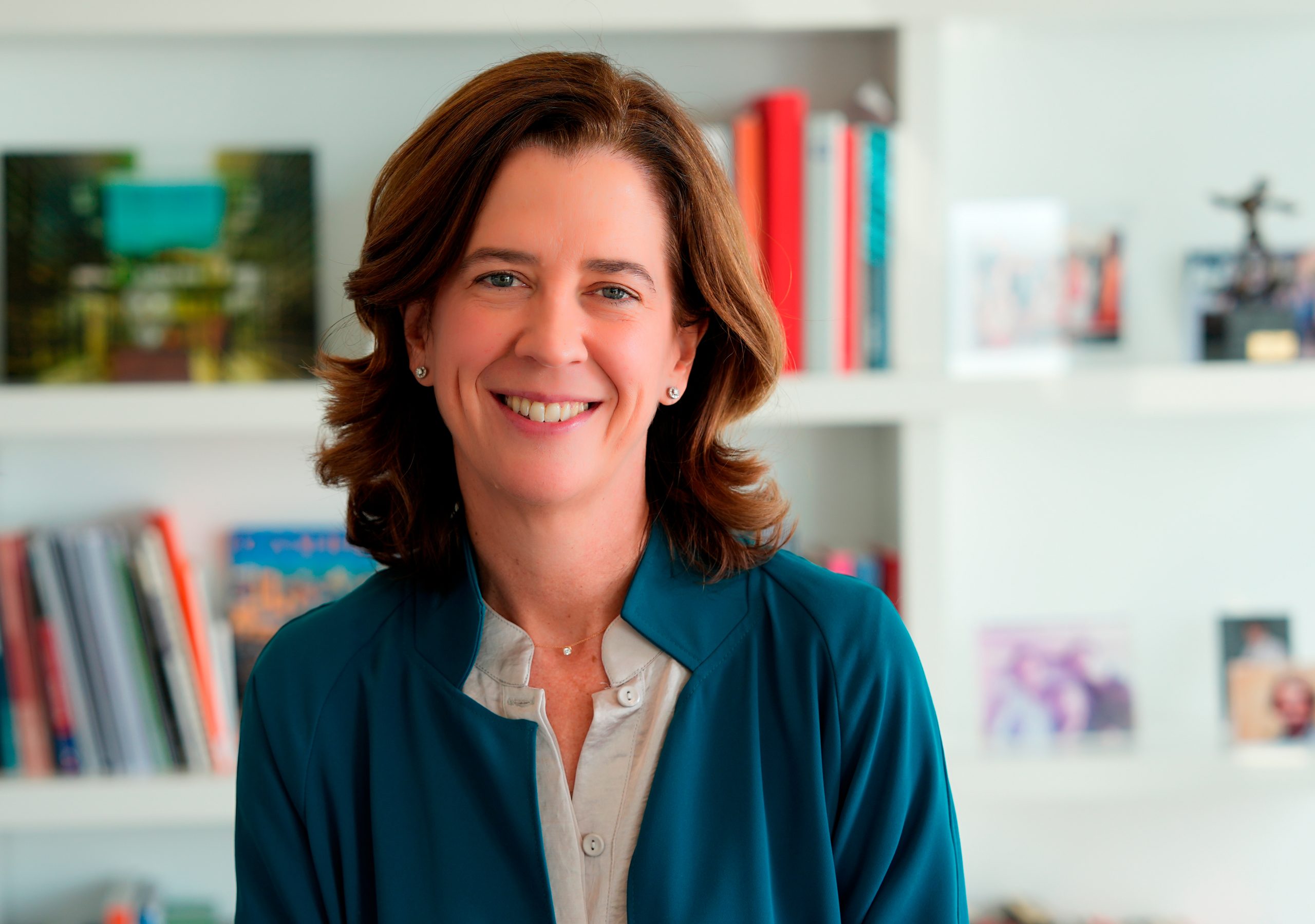
Born in Venezuela, she is the first woman to preside over the Spanish Banking Association. She has been in the position for one year, and among her main objectives is to change the negative image that Spaniards have had of the banking sector since the 2008 crisis. To achieve this, she has set out to give visibility to women who already hold positions of responsibility and to promote the expansion of both in-person and digital services.
Alejandra has a tightrope walker on the center of her office desk, pointing and gliding over the Madrid skyline. But she repeats more than once from her position as president of the Spanish Banking Association (AEB), located on the 30th floor of one of the Chamartín towers, that what she intends is to bring her sector closer to the street. She faces a difficult task… Today, those in charge of safeguarding our money do not enjoy a good reputation among citizens, and Kindelán believes that this reputation is unfair and poorly considered. But the banker has managed to break glass ceilings. It has also been complicated for a woman to hold her position as leader of the banking employers’ association for the first time in history, and she achieved it exactly one year ago in a context of looming crisis, albeit with spectacular economic results.
It came after a solid career at Central Hispano first and then at Santander, where she was responsible for the research department and public affairs. She misses the embrace of the tropics where she grew up in Caracas since her birth there in 1971. She lived in the Venezuelan capital until she moved to study Economics and Political Science at Wellesley University (Massachusetts), the first public women’s institution in the United States. Today she wants to promote the visibility of women in the hierarchies of a sector that, she says tactfully, is “traditionally male.”
In the face of financial system crises like those experienced in mid-March, do you know how to keep your composure?
The first thing I thought was: I need information to understand what is happening.
Rather than telling yourself: “Calm down!”
Well, I think I carry it within me. I’m not one of those who start screaming: “Oh, how horrible!” And, moreover, I feel the responsibility to convey it to the team.
Is that why you are in this position?
I don’t know, or yes, it’s one more factor, among others.
When did you know you were good with numbers?
From a very young age. When I was in Caracas at school, I was selected for the national mathematics olympiad. Also for chemistry.
What were you doing in Caracas?
My mother is Venezuelan and my father [who is Spanish] started working there between 1980 and 1987. I was very young.
What was that Venezuela like?
Wonderful. With spectacular nature, I had a great time. The social contrasts and insecurity were there. They shocked me. But when I think about it, I remember the light, the sea, the exuberance of the tropics.
Did you always want to work in banking?
No! I wanted to help the world. I studied Economics and Political Science for that purpose. Venezuela had left its mark on me. The turbulence. I wanted to help, to know and understand why a country with good and prepared people could end up doing poorly.
How did you propose to change the world?
I studied in the United States, at Wellesley women’s university, on the East Coast, and wrote a thesis on the quality of education. How the improvement of people was directly related to that. Upon leaving there, I went to the World Bank and then to Madrid to look for work somewhere that would help me continue understanding. I joined the research departments of banks and was hired at Banco Central Hispano (BCH). A wonderful experience, I loved it.
What did you learn there?
A lot. I delved deeply into European issues. We were experiencing the euro introduction phase. So I had to understand it and accompany people from the bank who went to see clients to explain it to them. I had a great time.
Did you go door to door? Like apostles of the euro?
I don’t know if that much…
Let’s see, how did you explain it?
Well, from the conversion factors: 166.386 pesetas for each euro. That it was good, necessary, that it would start as a virtual currency and that there would be a transition between that and the coins. I explained it beautifully.
Seen today, what you preached then, did it fall short for the better or was it worse?
Without a doubt, for the better. The euro has been an amazing factor of growth, development, and progress for Europe in general and for Spain in particular.
What a vision that was, wasn’t it?
Spectacular. Vision and leadership.
You belong to a generation that grew up with a dynamic: integration into structures like the EU. The 2008 crisis arrives and the dynamic reverses toward disintegration. Why?
I don’t know, in 2008, Europe responded in the financial sector with important steps. The banking union was established. Today we have a single supervisor, a way to resolve crises in our sector, a harmonization of European regulations, we have more tools that provide us with management criteria. Significant steps were taken from that point.
Globally, the steps continued, although the pandemic has affected the value chains that we must readjust. In that sense, I am not pessimistic. I believe we must reorder, perhaps we will move somewhat more toward regionalization, but not toward fragmentation.
I’m glad if the banking and financial sector sees it that way, but regarding social fractures, is it the same? Or has the one that began with the impoverishment of the middle classes led to disintegrating populist options?
In that aspect, yes. I agree. We have moved at two speeds. There came a time before 2008 when the world was better than ever. Poverty levels or armed conflict had decreased. Access to education and healthcare was very optimal. Inequality between countries had diminished, but within countries, no, that process of disintegration in social classes was observed. And that generated that polarization, to which we would have to add the effect of social networks. These are two issues to consider when measuring that polarization.
Did the 2008 crisis come about due to brutal deregulation of markets combined with the savage greed of certain sectors?
I would speak of mismanagement, I don’t know if savage greed.
Sorry, my voice as a boy educated in Catholicism came out and I gave a moral category to the question. But it was greed.
I don’t know, I’m not going to pronounce that word because then you’ll put it in the headline. I insist on mismanagement.
Caused by the compulsion for easy money and clear deception toward clients to get them to sign up for products like subprime mortgages?
There were bubbles there. Everyone is happy when things go up.
The trap of euphoria?
Exactly, everyone happy to benefit. But I don’t know if I’d define it as greed. Then things changed. Very drastically. The adjustments came.
Didn’t the banks’ research departments see it coming?
Perhaps yes, but it was difficult to predict when. Or to what extent. The trigger was those products.
Which were promoted with greed?
Possibly, although I don’t want to say it, you know, because of the headline. Let’s leave it at the exuberance that was later corrected.
You mentioned earlier that when you were an apostle of the euro, you first explained that the currency would be virtual. Today we can equate that to the process of closing branches of Spanish banks. The physical, the presence, has evaporated and some clients don’t understand it or know how to manage it. Greed or excessive savings?
Well, I think we are already fixing it. First, the phenomenon of physical presence is not exclusive to banking, but to all public and private services. We, as a sector, after the pandemic greatly accelerated that digitalization process, upon emerging we became aware, and that is true, because of the noise that existed.
Rather because people protested and started banging on the door.
Well, because of what was generated, our sector took it very seriously and began to apply measures that have gone much further than in other areas.
Why didn’t you do it before?
Well, because the pandemic radically forced us to adapt to the opposite. In fact, there is a significant portion of our clients who have not returned to the branch in the same way as exists in other fields. Today 81% of our branches are open from nine to two when a year ago it was half: 6.3 million clients over 65 years old have been served at that level or by phone, by a person. We have adapted font types, we have given digital literacy courses in which we have seen how many have learned to make a Bizum. We are making a tremendous effort. We have a clear roadmap. We experienced a very disruptive moment then. People like Carlos San Juan with his campaign helped us see it.
Have you reassured him already?
I think so, we were coming out of a very strange time and we learned. We took note and changed. Just as we have committed to continue with passbooks for those over 65 years old.
Did you have a passbook as a child?
I didn’t. But because I lived in Caracas and it wasn’t very common there. That’s what made me realize how advanced banking was when I arrived in Madrid. The fact is that now we must combine passbooks with mobile phones. Be excellent at one thing and the other. We have Bizum in Spain! With 23 million users. These are investments in ideas, in technology. We have to be there, in Bizum, but also in passbooks.
The pandemic truly disrupted everyone. It changed us. And you too?
Me too, I worked a lot. It has been the period of my life when I have worked the most. We did a lot in the banks, we were very concerned. Very much so. I was at Santander then. I had to understand what was happening and I was also dealing with regulatory issues. All parameters went out the window.
Could you feel the fear?
Fear, no. Uncertainty, yes.
There’s your balance again.
Balance, balance… Yes. I was on a safe ship. In Spain, our institutions are leaders in risk management, that is the key to banks. They are very good, they understand this business very well and when you see it, during the pandemic, it gives you great peace.
As much peace as the Government gave them when applying measures to withstand the disaster, from furlough schemes to the injection of funds?
Of course. Public-private collaboration was fundamental in that context. It worked wonderfully. The Government and social agents and private companies. The sector had worked a lot previously on crisis management: they called them war games. We had done several tests with real cases. And we had to provide solutions in the engine rooms.
But I’m sure no one ever imagined a situation like that. What did you have to compare it to?
With hacker issues, for example. But the important thing is that we knew who we had to convene, how to communicate with those above. All banks had done those exercises.
Do you think banking has a bad image?
I think we need to highlight the value of what we do.
Okay, but does it concern you that banking has a bad image?
It has an image that does not correspond to reality and we must work on that. The image of banks is measured in two spheres: general and particular. Banking and your bank.
For many, dissatisfaction with their own bank gives them a bad image of banking.
You can change institutions. We have measured it. Clients have a better image of their particular bank, but not a good one of banking. They’re around 70% to 75% satisfaction. But when you ask about banking, it drops. It has a bad image, it’s true, and I don’t really know why.
What has it done to be that way?
There are debts from the past. The 2012 banking crisis generated a bad image for the entire sector when what happened is that there were some poorly managed and highly politicized institutions, with unsustainable business models that went bankrupt. Today, those that are operating, in addition to surviving a very strong crisis, contributed 23 billion euros to that rescue through the deposit guarantee fund to bring it to zero. A very substantial part of the bill was paid by the healthy banks that are here today. For me, that idea of the bailout that is in the explanatory statement of the tax that the Government has announced on banking responds to an erroneous narrative.
Look at the bad image banks must have that it serves a Government to apply a tax on them and score a point in their favor. How do you explain it?
On the basis of two things: that banking was bailed out and we earn too much money.
Or simply, because in a context of crisis, we all have a hard time and efforts are required of us. Pitch in. A little more if possible, from those who earn the most. Easy to understand, isn’t it?
Well, and I respond. Pitch in, we’d love to.
But let’s not talk about metaphors, how much?
Yes, yes. But the thing is we are spending on fixing certain resulting problems. First, presence in rural Spain, which if it empties out, is not only the fault of banking.
Then, those that may arise due to possible mortgage debtors because of the rise in interest rates. There we have committed to a series of measures to soften the installments. We pitch in there too. And then, we pay taxes, the most. There is no banking sector in Europe that pays more. In the entire continent. In addition to distributing a dividend that reaches 5.6 million retail shareholders.
And then, why have many gone like crazy to queue to buy Treasury bills?
They pay beautifully, I think it’s a safe asset.
Many claim they do it because of the scarce benefits that banking provides.
I can say little about this. I should not comment on commercial practices of our institutions from the association.
So, yes.
We come from a world of excess liquidity and banks are returning to the European Central Bank. Whether they will pay for deposits, I don’t know. We are in a moment of interest rate normalization.
What will happen with interest rates?
I’m afraid they will continue to rise. Inflation remains high and the ECB’s duty is to control it. They are clear about it.
Did it seem strange to you that they appointed you to head the Spanish Banking Association, where a woman had never been designated for the position?
Strange, no. Here we are now. And we must normalize it.
From now on they are required by law. But is the financial sector still very sexist?
I don’t know if sexist, but it has been traditionally male. However, in our sector, many women hold very high management positions and one of the things I want to focus on is making that talent visible so that what you say doesn’t happen, that it doesn’t seem so. We will continue. The face of banking is not what it was years ago. We have to keep working to eliminate barriers, encourage and help them gain confidence in themselves.
And to lead.
And to lead… We lead very well, you know. Because we complement each other excellently with men.
What different sensitivity does a woman bring to leadership in the banking sector?
I think somewhat more empathy and social sensitivity or diversity, all of that I think is more present in women, although it is not exclusive to them. We have a bias more inclined toward that. I think it’s wonderful that it complements other capabilities. I advocate for diverse teams not only in gender, but also in sensibilities or backgrounds and experiences from other fields.
Well, you have demonstrated balance, not coldness.
That, since university. My professors told me they laughed when I said I was stressed. It was difficult to see me like that. But the procession goes on inside. My three children also help with that balance.
What ages?
A girl and two boys, 23, 21, and 16, the youngest turns.
Are they following mom’s path?
Not necessarily, but we’ll see. They know everything, they have a brutal level of information. They teach me many things, a good conversation with them is part of my personal balance. And it hasn’t been easy to combine career with motherhood. It hasn’t been. Everything was much more complicated before. Work culture has been radically transformed. There was no talk of work-life balance. The world has turned around in 20 years like never before. For better and for worse, in some aspects. For the better in this transformation of mentality. Before, it wasn’t even thought about. Also in socio-environmental issues, contacts with NGOs, that companies see themselves as social agents, not turning their backs.
And the bad?
The technological issue. Loneliness, social networks, that pressure, honestly, makes me sad. It’s something that can penetrate like poison and destroy families. It’s hard for me and gives me a bit of vertigo. I wonder how that can be changed, return to closer human relationships, to compassion for our fellow human beings. The species prospered through compassion, by caring for the weak of the herd, says paleontologist Juan Luis Arsuaga. And that, with the little machines… Ugh.
Interview conducted by Jesús Ruiz Mantilla