Home / Latest News / You may be interested in / Interviews / Kindelán: “Those harmed are the economy, businesses and families”
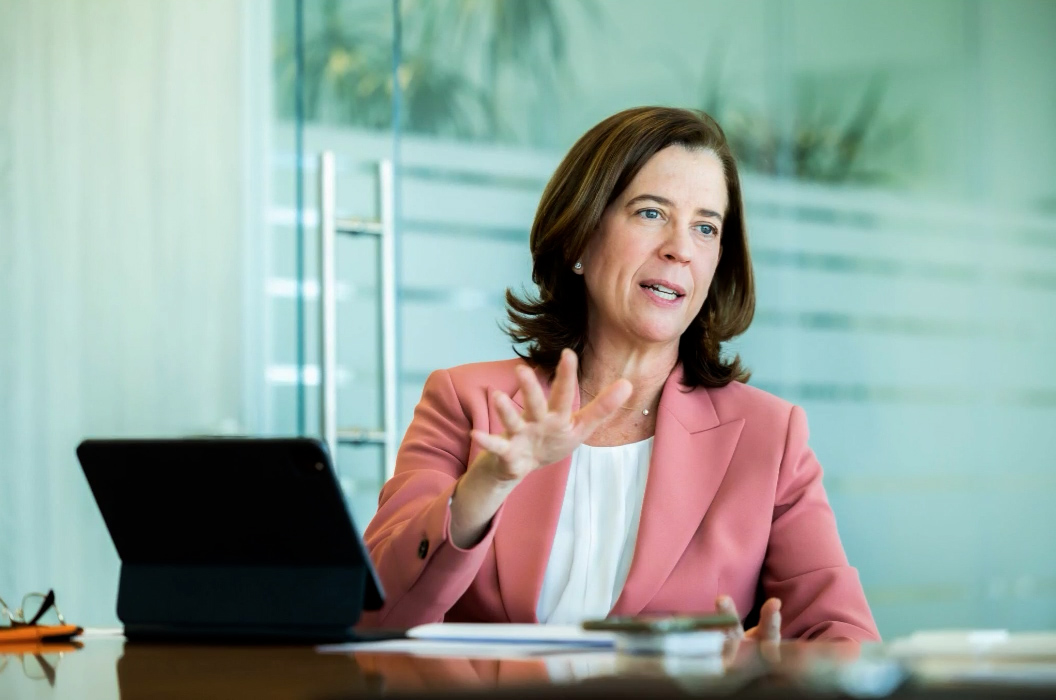
“With a permanent tax on banks, what is harmed is the Spanish economy, businesses and families.” This is how the President of the Spanish Banking Association (AEB), Alejandra Kindelán, sums up the consequences, in her view, of making permanent the special tax on the sector, which is currently temporary. Today, just as the deadline closes for submitting amendments to the law that will regulate it, the spokesperson for Spain’s leading banks laments, in a telephone interview, the lack of transparency with which the Government is conducting the process. “We do not know anything directly from any official source. It is somewhat disappointing that no one in the Government has informed us,” she notes.
Last week, financial institutions, through their trade associations (AEB and CECA), already warned of the consequences of the tax. “With a banking sector that is exemplary worldwide and in a very good position, what need is there right now to throw stones at our own roof?” reflects the President of the banking employers’ association.
Kindelán believes that the consequences of a hypothetical continuation of the levy “will not be seen today or tomorrow, but in the medium and long term the economy will of course be affected, and especially SMEs”. Why? “Because in risk-weighted assets, SMEs carry the greatest weight. Therefore, they will possibly be the most affected.” The employers’ association Foment has calculated that, in Catalonia alone, a permanent tax on financial institutions would reduce available credit by around €9.5 billion. And roughly half of that amount corresponds to SMEs.
In the two years the levy has been in force, annual revenue has been around 1.5 billion. If it were extended and that same figure were maintained, the capital available to banks would be lower and, therefore, they would not be able to offer as much credit, and it would not be backed by a cushion of resources.
Kindelán recalls that in other countries such as Italy, the money from the tax has been used to strengthen institutions’ capital. “Here we have not even been able to talk about this, because we have not had the opportunity,” she says, before adding that the decision taken in Italy “is also the recommendation made by international bodies”.
The imposition of the tax, therefore, the banking association argues, harms institutions’ solvency. First, because it undermines their ability to generate profits. “Profitability is the first line of defence for banks. Without profitability, we do not have solvent banks; we do not have banks capable of continuing to provide credit,” explains the President of the AEB.
Kindelán notes that after years of expansion, “more than half of the sector’s results—around 60%—are being generated outside Spain”. And those banks compete globally with those in other countries that do not have that burden. “We would lose competitiveness against our competitors in other parts of Europe and the world. And at a time when what we want in Spain is to keep growing, we have a huge opportunity.” In her view, “for that we need a strong banking sector, one that continues to provide credit also for investment. We have seen how investment in Spain has been weaker. What we want now is more investment. Companies that can continue to develop their projects and families that can also continue to pursue their projects.”
The possibility of making the tax permanent also comes at a time when the interest-rate environment has changed, shifting from an upward trend to a downward one. “The tax, whatever the evolution of the economy, whatever the evolution of the markets, will tax revenues. It does not take into account institutions’ economic capacity. Taxing revenues seems not to respond to, or take into account, what may happen with the economic cycle, with the interest-rate cycle.”
Precisely regarding the current rate environment, Kindelán recalls that “the levy was justified because there was an extraordinary moment, when it was said there were extraordinary revenues, something we never agreed with either. But the fact is that right now interest rates are falling.” And the stock market is already reflecting that situation: “We have seen some financial institution publish results and the market has not reacted as favourably as one might expect, because despite the excellent results, the market is already seeing this impact of falling interest rates. And I think that should make us think,” she concludes.
Interview conducted by Eduardo Magallón