Home / Latest News / You may be interested in / Articles / Women’s visibility in banking: the best antidote to stereotypes
What is not known cannot be desired or aspired to. This very basic premise is one of the issues we must work on to strengthen the role of women in certain sectors and positions of responsibility, and to put an end to certain stereotypes.
The project “Draw a scientist test” is often cited, in which children and teenagers in the United States had to draw a scientist (in English, the term is gender-neutral). At the end of the 1960s, barely 1% drew a female scientist. This percentage has improved among the youngest children—those aged 5 and 6—reaching almost 30%, but as they grow older the percentage decreases. It seems clear that the lack of female role models dedicated to science in series, films, news programmes, video games, books… conveys the idea that science is an occupation that is mostly male.
To my knowledge, no researcher has raised the same question about the banking sector, but I would venture that if a similar proposal were made, the percentage of children who would draw a woman would be the same or lower. Some might even revive that stereotypical image of the banker with a cigar and top hat from some film—an image that some still resort to when criticising the sector—but that is another story.
Why, if women make up at least half of banks’ staff and their presence is increasingly greater and in more senior roles across all departments—from business to technology, as well as others traditionally with more women such as marketing, communications or branches? Why, if in Spain two women are chairing major institutions such as Santander or Bankinter, representation on boards reaches percentages close to 40% and the number of female executives increases significantly?
Once again, the reason lies in visibility. If it is not told, if it is not seen enough and there are too few opportunities to hear from women role models, the career possibilities offered by a sector such as banking—where one can build a broad and varied professional career—remain unknown.
That is why, in addition to appealing to the media, fiction creators, filmmakers…, those of us with responsibility must make an effort to exercise public leadership to showcase our work. This is useful so that younger people get to know us, and also to improve and drive women’s careers and aspirations. One of the most intense moments of my professional life was when, upon changing jobs, a young woman I barely knew came up to say goodbye and told me: “You have been a role model for me.”
Showcasing women leaders in the sector is one of the objectives of Women in Banking, the association we founded two years ago and of which I am honorary president. This work is complemented by awareness-raising, good practices, mentoring, attracting and developing talent, as well as producing reports with analysis and data on equality and diversity—true drivers of productivity and a positive workplace climate.
It is a day-to-day task, and I hope that if at some point someone proposes a test of drawing people who work in banking, we will find drawings of female cybersecurity experts, chief executive officers or heads of business.
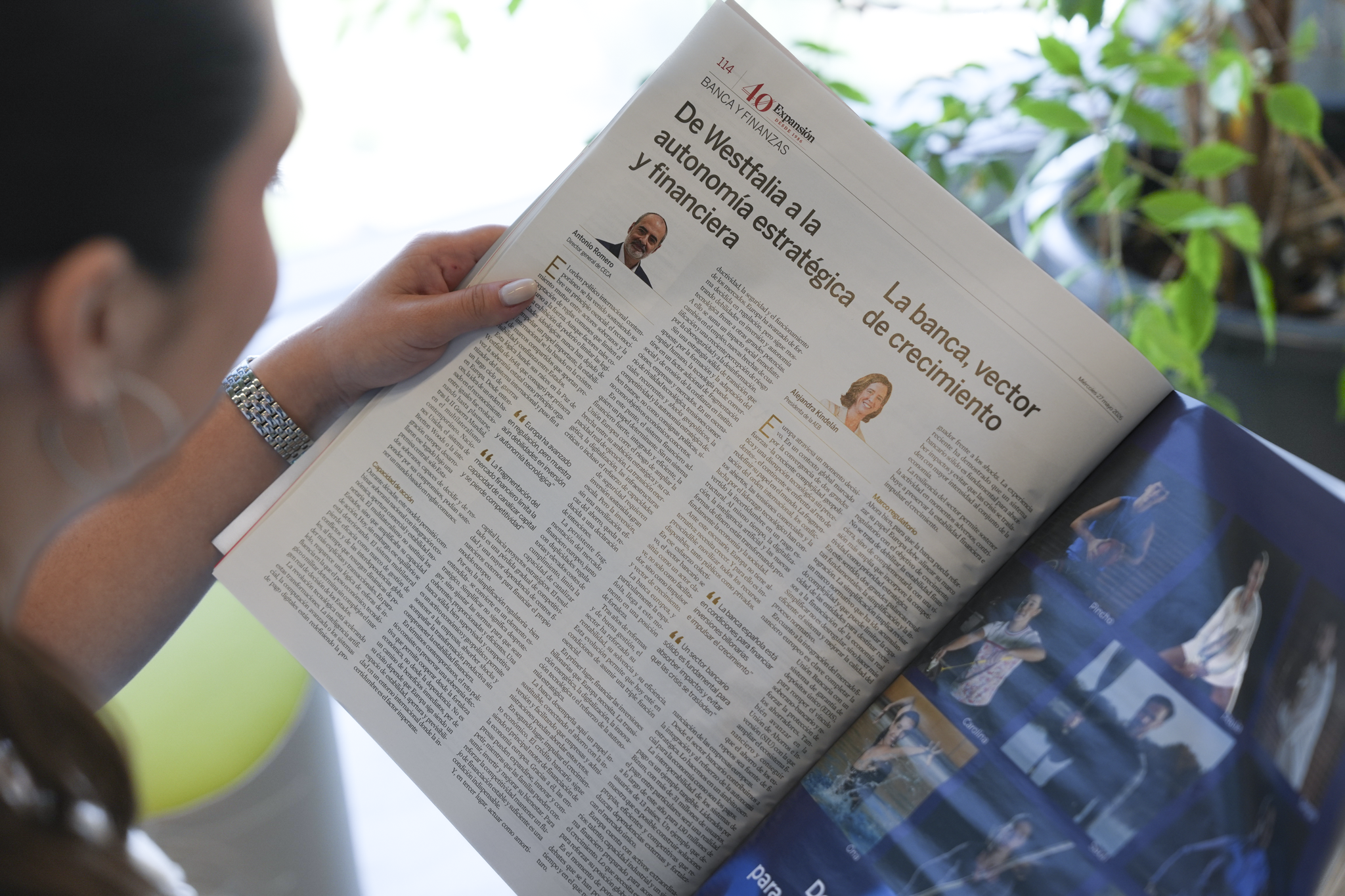
Alejandra Kindelán, President of the Spanish Banking Association