Home / Latest News / You may be interested in / Articles / The Value of Financial Education in Schools
This week marks ‘Global Money Week’, a worldwide campaign held every year to raise awareness about the importance of financial education in schools. It is important that young people, from an early age, acquire financial competencies with knowledge and skills, as well as attitudes and behaviors so that, throughout their lives, they can make informed and considered financial decisions.
Only 18% of European citizens have a high level of financial knowledge, 64% have a medium level, and the remaining 18% have a low level. This was the main conclusion of the Eurobarometer published by the European Commission at the end of last year. Furthermore, there are significant differences in these figures among different countries. Only four countries reach 25% of citizens with extensive financial knowledge, and Spain is not among them.
The European Council, after analyzing these results, concluded that new measures must be taken urgently, starting in schools, to promote financial knowledge in society. In its assessment, it maintained that financial literacy is important for improving citizens’ well-being and strengthening their financial inclusion, so that they are better prepared for the future and make investment decisions with sufficient information and considering all existing possibilities, such as those derived from capital markets, which ultimately also contributes to financial stability.
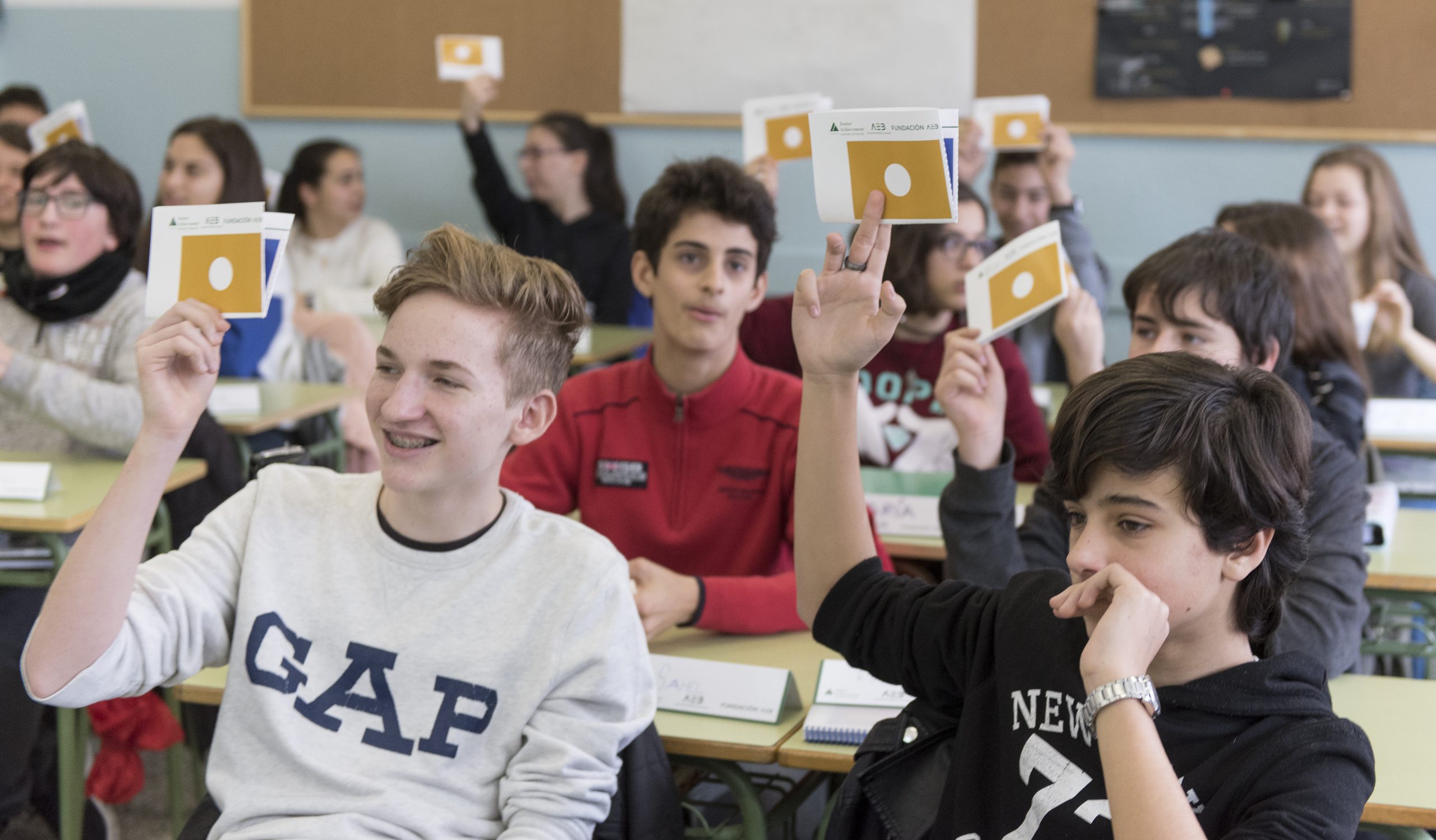
In our country, for more than 10 years, the foundations of the Spanish Banking Association (AEB) and Junior Achievement Spain have brought financial education to schools and institutes throughout Spain through the “Your Finances, Your Future” program. During this period, more than 70,000 young people have benefited from the Program, in which nearly 5,000 banking and AEB employees have participated. The dedication, enthusiasm, and commitment of all these volunteers have been key to obtaining very positive results and a high degree of engagement, as shown in surveys of students and schools.
This program is developed through three sessions: the first introduces financial education through two basic concepts in financial management, namely budgeting and saving. Next, a session to discover planning as an effective method for making non-impulsive decisions and promoting responsible behavior, also in terms of sustainability. Finally, a reflection on the different existing channels for financial management and the importance of cybersecurity is addressed.
Thus, in the design of the sessions, student participation and group reflections are prioritized above all. The aim is to evaluate real cases and examples and encourage them to reach their own conclusions. All of this enhances non-cognitive skills, social and personal capacities for decision-making. And, above all, it responds to a dual objective: to introduce young people to financial education and also to encourage them to continue their education in the future, contributing to strengthening their responsibility in managing their finances.
In line with this initiative and with the European Council’s recommendations to bring financial education to a very early age, last year the two foundations also launched the free financial education program “Finance in the Community” for students between 9 and 12 years old.
Through stories, games, and role-playing, students in 4th, 5th, and 6th grade of primary school learn about how society and the economy function, and discover the dynamics of work, income generation, expense management, and the relationship among all of them.
In short, throughout our lives we face many decisions, and a good part of them relate to our finances. And it will be easier to manage these situations when we have the necessary resources. Information provides us with materials and education gives us tools that will help us better manage our personal finances. The sooner we access these capacities and competencies, the more solid they can become and the further we can take them.
This is why we advocate for financial education to be part of compulsory education in schools, thus providing from an early age an essential tool to facilitate our daily lives, to make our personal projects a reality, and also to advance collective progress.
José Luis Martínez Campuzano, Spokesperson for the Spanish Banking Association