Home / Latest News / You may be interested in / Articles / “Banks bear €270 billion in extra capital due to supervisory discretions”
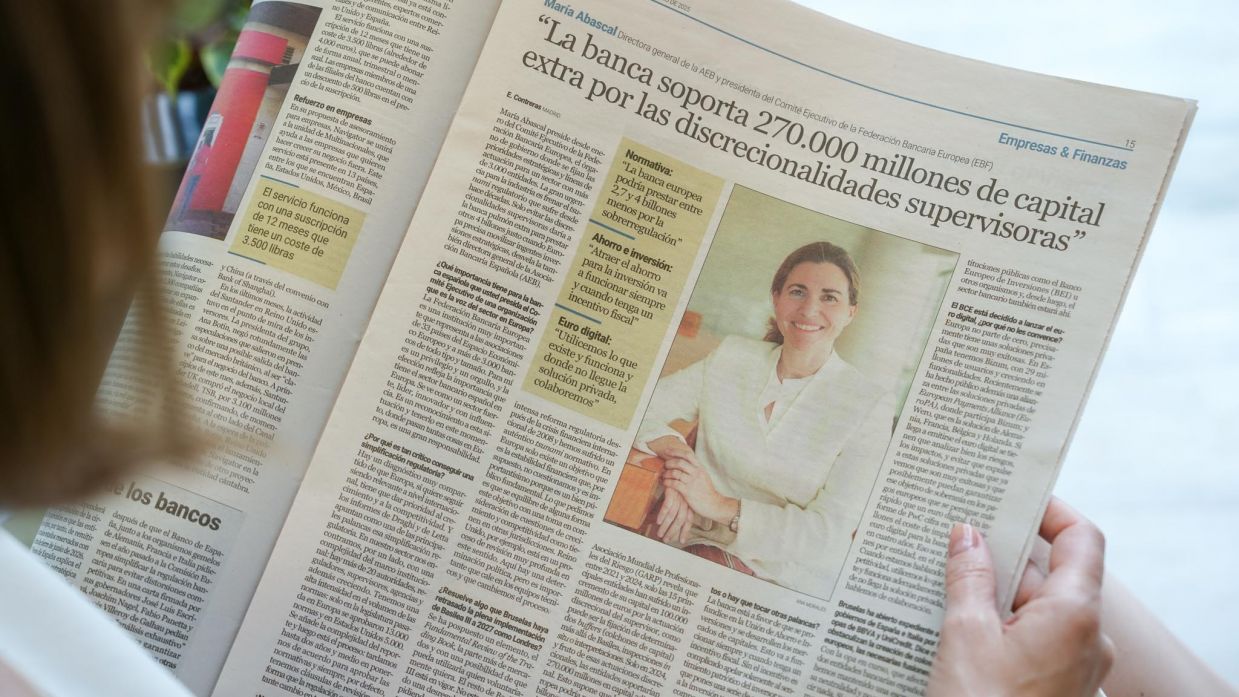
Maria Abascal has chaired the European Banking Federation’s Executive Committee since January, the governing body that sets strategic priorities and lines of action for a sector with more than 3,000 institutions. The industry’s great urgency is to halt the regulatory tsunami it has suffered for decades. Simply avoiding supervisory discretions would give banks additional capacity to lend another €4 trillion precisely when Europe needs to mobilize massive strategic investments, reveals the Director General of the Spanish Banking Association (AEB).
How important is it for Spanish banking that you chair the Executive Committee of an organization that is the voice of the sector in Europe?
The European Banking Federation is a very important institution representing the associations of 33 countries in the European Economic Area and more than 3,000 banks of all types and sizes. For me it is a privilege and a source of pride, and the election reflects the importance of the Spanish banking sector in Europe. It is seen as a strong, leading, innovative, and influential sector. It is recognition of this situation, and having it at this moment, when so much is happening in Europe, is a great responsibility.
Why is achieving regulatory simplification so critical?
There is a widely shared diagnosis that Europe, if it wants to remain relevant internationally, must prioritize growth and competitiveness. And the Draghi and Letta reports identify regulatory simplification as one of the main levers. In our sector we face, on the one hand, the complexity of the institutional framework: there are more than 20 authorities, regulators, supervisors, agencies, and they continue to grow. We have high intensity in the volume of regulations: in the last legislature alone, Europe approved 13,000 regulations and the United States 5,000. The complexity of reporting is added, and then there is the process: it takes us up to two and a half years to agree on approving regulations, and we always have review clauses by default, so that regulation is constantly changing in all areas…
Has the pause not occurred?
We have been experiencing this intense regulatory reform for more than 15 years following the 2008 international financial crisis, and we have suffered a genuine regulatory tsunami. In Europe there is only one objective, which is financial stability, which we certainly do not question and is extremely important because it is a fundamental public good. What we ask is that this objective be somehow balanced with consideration of growth and competitiveness issues as they have in other jurisdictions. The United Kingdom, for example, is undergoing a very thorough review in this regard. There is political determination here, but it is important that it permeates the technical teams and that we change the process.
Does it resolve anything that Brussels has delayed the full implementation of Basel III to 2027, as the United Kingdom and the US have already done?
One element has been postponed, the Fundamental Review of the Trading Book, the market-related part, with the possibility that it can be used voluntarily by those who wish. The rest of Basel III is in force. We are not asking for deregulation; we are not asking to reopen Basel III. We think it is appropriate because it gives us certainty. The problem comes from the capital add-ons or the tightening that occurs with regulatory developments and an excessively complex macroprudential framework. A recent study by the Global Association of Risk Professionals (GARP) reveals that between 2021 and 2024, the top 15 institutions alone have experienced an increase in their capital of €100 billion due to discretionary supervisory action, such as the setting of certain buffers beyond Basel, on-site inspections, or interpretations. In 2024 alone, and as a result of these discretionary actions, institutions would bear €270 billion in additional capital. This means that European banks could lend between €2.74 and €4 trillion less in credit. For every 100 basis points more in capital, credit falls by 10%, and this occurs at a time when Europe has very significant financing needs and 75% of financing is bank-based.
Are the supervisor and regulator open to removing that layer of singular elements that penalize the sector?
That is the work we now have on the table. There is political determination, and it is important that awareness be generated, that there be a change in mindset that we can leverage, that we be ambitious, and that we act quickly. On the horizon there is an important report for this work: the European Commission will analyze the competitiveness of the banking sector in 2026. And then, as longer-term issues, we would need to analyze whether there are overlaps between institutions and regulators. They often work in silos, and we do not have a holistic view of all the requirements being asked of the sector and what impact that has on competitiveness. It is about changing the mindset so that regulators, while safeguarding financial stability, can also incorporate competitiveness analysis of the sector. The United Kingdom is already doing this, and the United States has said it will implement it. Europe cannot isolate itself; bureaucratic burdens must be reduced. A recent PricewaterhouseCoopers (PwC) report stated that the capital level has tripled if we take into account MREL requirements. In other words, the solvency, robustness, and strength of the sector are beyond question, especially because capital requirements have tripled while risk is at minimum levels. And the banking sector is more important than ever now to finance all these challenges that Europe faces: decarbonization, innovation, the technology gap, defense… It is clear that, with public resources, we cannot finance the scale of the challenges we have.
Brussels is precisely promoting the so-called Savings and Investment Union to mobilize savings toward the productive investments that are needed… Is it enough to label products, or must other levers be activated?
Banks are in favor of deepening the Savings and Investment Union and developing capital markets. This will work provided there is a tax incentive. Without the incentive, it is difficult to appeal solely to the investor’s patriotic sentiment because you impose a series of conditions on the investment and in return you must compensate with the tax incentive.
Does regulation make it difficult for banks to finance the defense sector?
Defense is a priority in Europe. It is a value-added sector that can generate jobs. There is no regulatory obstacle as such, and banks are prepared to provide financing. The problems there are like those of any sector: large companies have no problem, but if you have a more fragmented world of companies, they may have somewhat more difficulty. We see that there is political determination to support this sector and from public institutions such as the European Investment Bank (EIB) or other organizations, and certainly the banking sector will also be there.
The EBF came out in support of Spanish banking last year and against the tax for the sector. What harm does it cause when governments use special taxes to meet the needs of political programs?
I am not revealing anything if I tell you that we do not support this tax. We believe it is a political tax and lacks technical foundation. So it is concerning because, in the end, it reduces attractiveness and competitiveness for a sector.
Regulations such as the FiDA regulation and open finance are coming that will require the sector to share data almost completely. What risks does this new regulation entail?
The sector will always be in favor of innovation and a coherent and proportionate digital strategy. We have always advocated for an intersectoral data-sharing framework because that is where the benefits of the data economy occur and where citizens will be able to be offered that innovation and those value-added services in their products and services. With FiDA, all that is being done is deepening within the financial sector without data from other sectors being available, and this is a very limited approach. This, on the other hand, generates gigantic investments to create the schemes and open a multitude of data. So what we ask is that, at the very least, it be reviewed so that it is based on real market demand. It makes no sense to open all data if it will not be used later because that would be inefficient and dedicate banks’ innovation budgets to matters that will not be utilized.
The ECB is determined to launch the digital euro. Why does it not convince you?
Europe is not starting from scratch; it has very successful private solutions. In Spain we have Bizum, with 29 million users and growing in functionalities. Recently, an alliance between the private solutions of the European Payments Alliance (EuroPA), where Bizum participates, and Wero, which is the solution from Germany, France, Belgium, and the Netherlands, was made public. If the digital euro is issued, the risks and impacts must be carefully analyzed, and it must be prevented from displacing these private solutions that we already see are very successful and that can possibly guarantee that objective of European payment sovereignty that is being pursued faster than a digital euro. A PwC report estimates the cost of implementing the digital euro for European banks at €18 billion over four years. That is €110 million per institution, on the low end. When we are talking about competitiveness, let us use what already exists and works properly, and where the private solution does not reach, let us talk about collaboration.
Brussels has opened proceedings against the governments of Spain and Italy over the BBVA and UniCredit takeover bids. It says they are obstructing the creation of European giants, the necessary mergers…
With the takeover bid underway, which affects two Spanish banking institutions, we have maintained scrupulous neutrality and I will not be able to say anything. If you ask me about the European dimension of cross-border mergers, undoubtedly, there is frustration that, in the end, progress is not being made. The International Monetary Fund (IMF) quantified in a recent report that we have barriers in the European single market that are equivalent to a 45% tariff on goods and 110% on services. So, indeed, if we address these barriers we achieve significant benefits in terms of growth and competitiveness, and that is where we need to focus. And for that, what do we need? Undoubtedly, the Banking Union must be completed with the creation of a European Deposit Guarantee Fund, and we must also continue deepening the harmonization of certain legislation.
Interview conducted by Eva Contreras