Home / Latest News / You may be interested in / AEB Informs / The financial education young people want
Once again, we are celebrating Financial Education Week in the hope that young people will add basic economic and financial concepts to their knowledge base, ensuring they become informed and responsible consumers, ready to take their first steps towards financial independence.
In Spain, as in many other countries around us, this effort has been based on two major lines of action. On the one hand, awareness-raising campaigns remain a tool used by national authorities to reach a broad cross-section of the population and, in certain cases, to alert consumers to potential risks linked to the use of financial products and services, such as those associated with the use of cryptocurrencies. The National Financial Education Plan led by the Bank of Spain and the National Securities Market Commission is an excellent example of this type of initiative. In parallel, financial education in Spain tends to be approached through the traditional transmission of basic concepts, almost always focused on a theoretical rather than practical or experiential framework. However, the results of this dual approach, although commendable, are limited both in performance and in reach.
Technology should be added to ongoing training programmes in financial knowledge as an ally of education. If there is one thing to bear in mind, it is the importance of technology in our daily lives and the need to use it appropriately in order to manage our resources better. Financial training is a necessity; it protects us from impulsive and poorly thought-out decisions that a world like today’s, dominated by immediacy, can lead us to make. Developing non-cognitive skills, such as controlling our impulses or delaying gratification, fosters responsible financial skills and habits, as it enables us to identify behavioural biases that encourage us to behave like most people around us, without any criterion to justify it, or to give more importance to short-term decisions than to assessing their long-term impact.
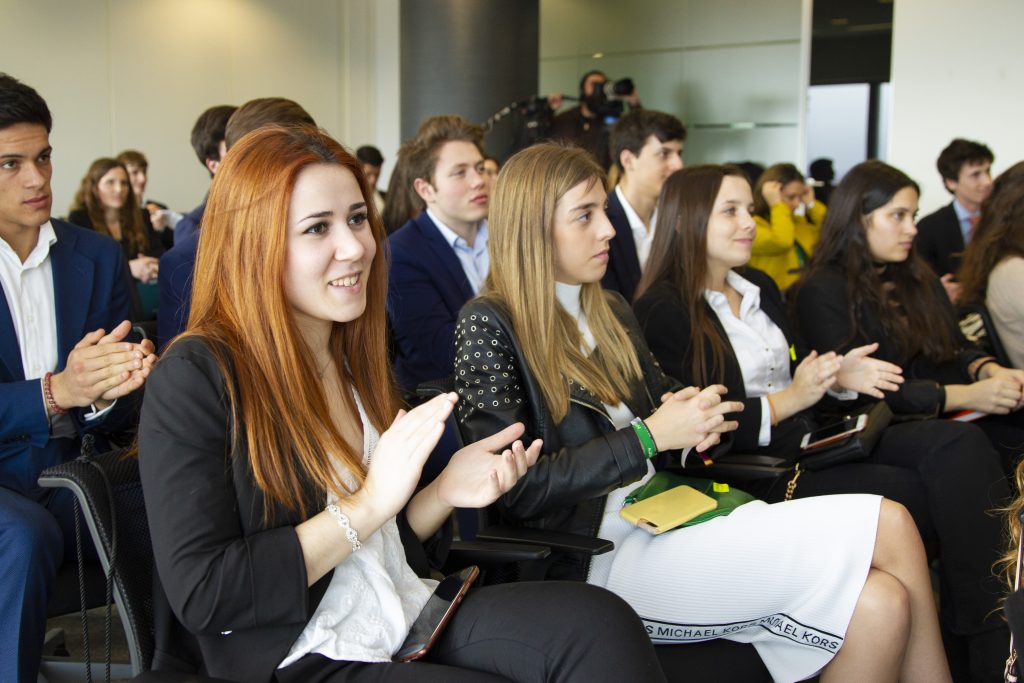
Faced with this mix of possible alternatives to make financial education more effective in Spain, at AEB we thought it would be interesting to ask CUNEF economics and business students—until very recently teenagers with limited knowledge of economics and finance—what kind of learning they would have liked to receive to face their first years of adulthood with a more solid understanding of financial matters. To that end, at the beginning of this year we set them an experimental exercise with very interesting results.
Most of the more than 60 proposals prepared by 250 students considered the proper use of technology to be key for teenagers to internalise basic financial concepts. These papers agreed that it is necessary to make the most of technology with more flexible, practical and less theoretical approaches, adapted to the needs of each group, whether centennials or millennials or even younger. 40% of the ideas put forward suggest learning based on decision-making and behavioural biases using gamification tools, and 20% propose learning through practical methods and real experiences, such as visits to companies, or the creation of a finance club, a “school bank”, or turning the library into a “Stock Exchange”.
Two surprising elements also emerged from this exercise. Despite the popularity and influence of social media, the proposals did not reflect trust in influencers as vehicles for raising awareness (only 5% of the ideas proposed this approach). Conversely, what was also striking was the trust in formal education (33% of the proposals), provided that physical and digital materials are combined and complemented with practical exercises and activities on technology platforms.
In short, the experience showed us that, beyond the traditional transmission of knowledge and awareness-raising campaigns, it is essential to redesign financial education programmes with more innovative activities, a more modern approach to new technologies and new materials that are engaging, easy to use and tailored to each age group, enabling practical training in managing their financial resources.
Juan Carlos Delrieu and Conchita Morán Sangochian, Strategy and Sustainability Directorate