Home / Latest News / You may be interested in / AEB Informs / Interview with José María Roldán in ABC
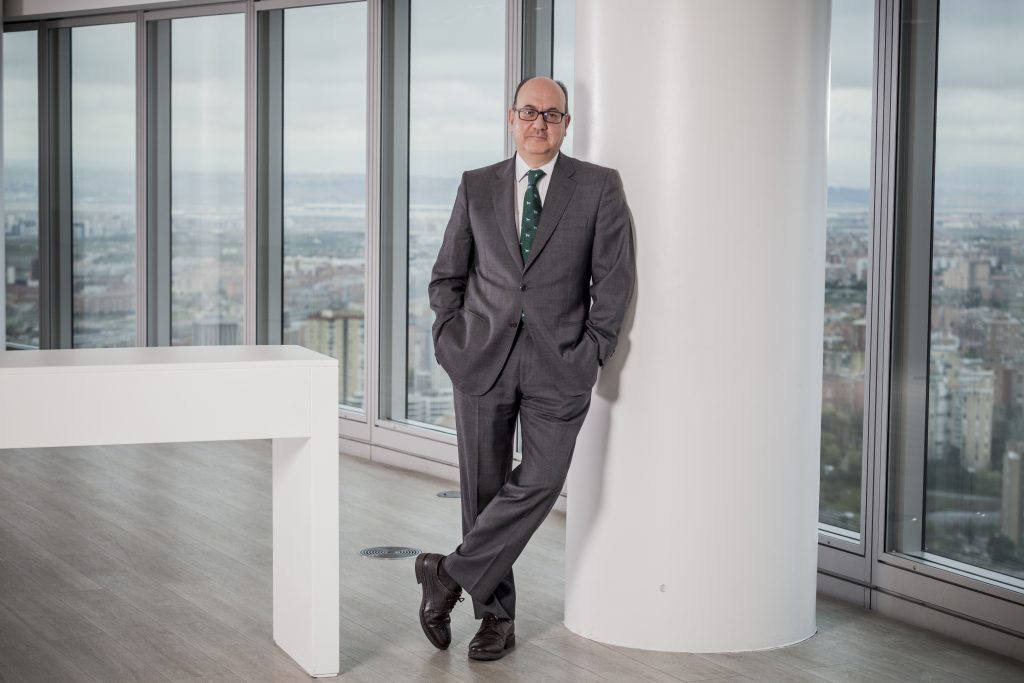
Four years ago, the major banks chose José María Roldán to represent their interests from the Spanish Banking Association (AEB) at a time when the sector’s reputation among the public was at a very low point and profitability was meagre. “Things have been more complex than I would have thought,” he admits after being re-elected for another four years, a period in which institutions face major challenges despite the economy being in a favourable phase of the cycle.
—Is it a sustainable recovery?
—It is consistent: it is creating jobs very strongly, perhaps not of the quality we would like, and we are growing without generating imbalances. It is healthy growth, but it is not enough in the long term. We have to be ambitious and consider what structural reforms we can implement to improve it.
—Is there a problem of low wages?
—The recovery is important, but it seems to be leaving segments of society behind, either because they cannot access employment or because that employment is not of the quality it was before the crisis. It is not a Spanish phenomenon; it is global, it affects young people more, and it is a reflection we must make.
—And the pay gap? Is banking still a man’s world?
—It is not a problem exclusive to banking, but to society, and we must take it as seriously as possible. It is unacceptable for there to be discrimination based on sex or any reason other than effort, training and ability. In banking, the issue is in management positions associated with motherhood. When that happens, women miss the train of their professional career. We must study what can be done to remedy it.
—Could banking suffer a data theft like Facebook?
—We protect customer information very well. For example, it is not widely known that we do not store customers’ passwords for accessing their services. They are perfectly protected because there is no place someone can break in, smash the glass and take them; there is an encryption system that prevents it. It is a clear example of the seriousness with which we take the need to protect our customers’ data. This is how we have done it historically.
—Would customers pay the cost of a tax on banks to fund pensions, as proposed by the PSOE?
—The banking sector is not the main driver of this problem, which is structural and requires agreed solutions. We will have to contribute to its solution, but there is no reason why the banking sector should have to make a greater effort than other sectors.
—Has banking regained customers’ trust?
—There have been times when the sector’s image has suffered, but we have always had trust. Customers must understand that relationships with them are medium- and long-term; this is not a sector that tries to make short-term gains.
—But mortgages are still causing an enormous amount of litigation.
—We are probably seeing the final stages of that litigation; there are no major issues left.
—What must banks do to regain 10% profitability and improve their stock market valuation?
—There are things that depend on banks, such as providing better customer service, controlling costs and carrying out the digital transformation. But the normalisation of interest rates, which will help, depends on central banks. It seems we are moving in that direction, but it will be slower than expected and, moreover, the new rates will be lower than before the crisis.
—Will there be further network adjustments?
—The decline in employee numbers is slowing, but as for branch closures, it cannot be ruled out that they will continue, especially given the digital transformation process.
—And are mergers a way to improve profitability?
—They are one of the solutions, not the only one, but indeed this industry has increasing returns to scale and therefore size helps. That does not mean there cannot be specialised institutions—small, local, and mid-sized.
—Why are there none at European level?
—Because we are in a banking union in law, but not de facto. Supervisors still put obstacles in the way of deposits in Belgium being used to finance SMEs in Italy. We have made a lot of progress, but there are still pockets of liquidity and solvency trapped within the borders of member states. There are local regulations and actions that do not allow those funds to be moved to countries where profitability is higher. If that improves, we will see those mergers.
—You say banks could cooperate in rural areas to avoid possible financial exclusion resulting from that adjustment. How would they do it?
—Looking at experience in countries with remote-area challenges such as Canada and the U.S., there are cooperation mechanisms between banks that make it possible to provide these areas with financial services while not incurring unsustainable costs: mobile branches, multi-bank ATMs, etc…
—Should the State speed up the privatisation of Bankia?
—As a taxpayer, what I want is for the State to maximise the recovery value because, to the extent it does so, it will minimise the cost of the bailout. But it is not easy to do.
—Is a merger with CECA among your plans for the new term?
—Now we are all banks based on shareholder structures and there is a great similarity of banking models. From that point of view, when I defend AEB’s interests I am also defending CECA’s. We must consider whether we can be more effective by organising ourselves differently. A single voice is more powerful than two voices, without any doubt.
José María Roldán, Chairman of the Spanish Banking Association