Home / Latest News / You may be interested in / AEB Informs / “In Spain, we have a good level of banking competition”
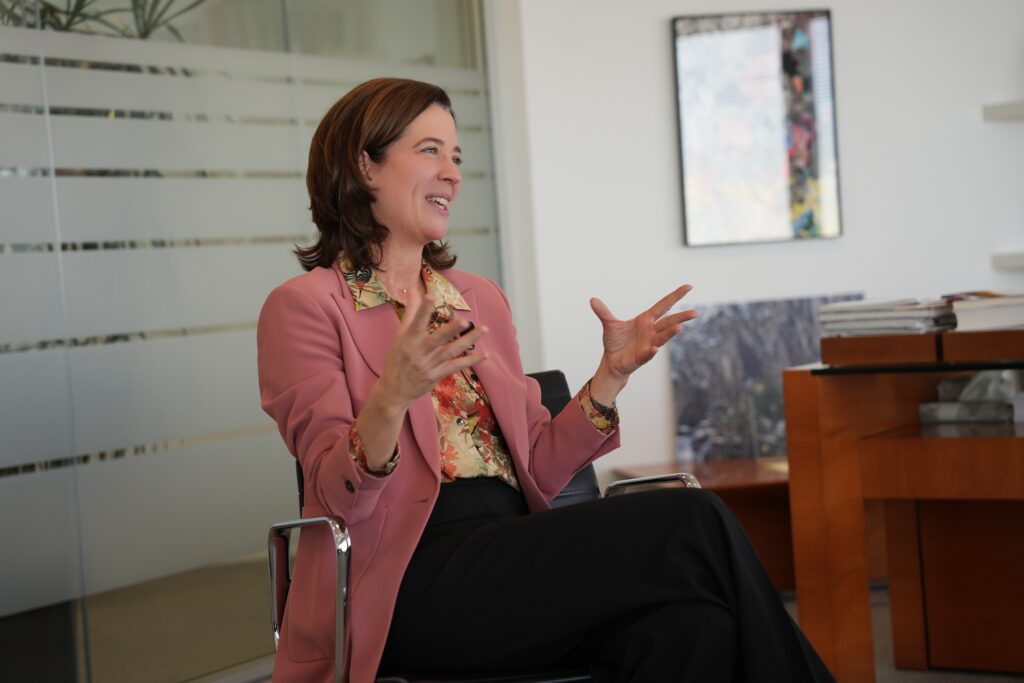
Born in Venezuela 51 years ago, the president of the Spanish Banking Association (AEB) since April 2022 participated on May 26 in a conference in Valencia on ‘Seniors facing the digital divide’ organized by the Mapfre Foundation. She states that only 3% of young people have enough savings to pay a down payment to buy a home, but that 40% of them can indeed afford the mortgage payments. She advocates for formulas such as guarantees.
Can we believe that the banking turbulence generated by the Silicon Valley Bank and Crédit Suisse crises has passed, or is it better to be cautious?
The financial conditions of the economy have changed radically in a very short time. Interest rates have risen sharply. What we must be sure of in Spain is that we have a banking sector well-prepared to handle this change. We have a very commercial banking model, which has nothing to do with banks like Silicon Valley or the problems at Crédit Suisse, which had faced profitability difficulties in recent years. Spanish banking is showing strength and profitability, with very solid balance sheets and enormous diversification. Silicon Valley and some others failed because of their business model. We are well-prepared.
Could phenomena like Silicon Valley Bank be repeated?
The market is very large. These are international phenomena. They came from outside. We start from the foundation of a solid, healthy, and profitable financial sector.
The sector has been very combative regarding the bank tax, yet first-quarter results have been very good. How do you justify that contradiction?
We are coming from a decade of negative interest rates. Now, the change in conditions is normalizing rates and also profitability levels. One must understand the big figures, the 20 billion euros in profit in 2022. I understand they draw attention because it is a very large figure at a time of inflation and economic slowdown. We have banks here that are among the top in the world and generate a very significant part of their profits abroad. In the case of Santander, it is 85%. BBVA said 65%/70%. In the end, the total is 42%, which must be excluded. Of the rest… Half of the profit generated is retained to build reserves and continue lending to families and businesses. The other half of the profit is distributed as dividends to 5.6 million shareholders, many of whom are small retail investors who supplement their income with that dividend. Spanish banking is the sector that pays the most taxes in Europe. 51% of the profits of Spanish banks go to taxes. If we include the new levy, we exceed 60%. When the proposal for that tax arose, we said it was arbitrary and stigmatized the sector. What the supervisor tells us is that the rate hike can help margins in the short term, which is what is happening now, but insists that in a context of uncertainty, there are also negative effects for banks from that rate hike that may be seen now, such as reduced activity. We are already seeing that credit is slowing down and there is more delinquency, although it is at record lows, which means provisions must be made that reduce results. The regulator asks us for prudence. In this context, do we think a bank tax is a good idea? Well, no.
What can the banking sector do to improve financing for young people’s access to housing?
In Spain, we have a mortgage market that works very well, so well that the homeownership rate is 75%, and that is due to the dynamism of the mortgage market. Regarding access for young people, I believe formulas are being proposed that we find appropriate. What we have measured is that a significant portion of young people between 25 and 35 can afford a mortgage payment but cannot afford the down payment.
Of course, now banks only provide 80% of the loan and not the 100% or 120% seen before the Great Recession.
That is in the past. It was an era of excess. Now, 80% is the norm. Covering that 20% with savings is difficult for young people. Only 3% of young people in that age group can afford that down payment, whereas more than 40% of them can afford the monthly installment. How to address this situation? We believe that the formulas being proposed, such as a guarantee, are the way to go.
Will we see more mergers in Spain in the near future?
We have had a very strong consolidation process over the last decade. The sector has been reconfigured, and we now have a level of concentration that I would say is average when looking at international comparisons. We have a very good level of competition and efficient entities. In general, I do not think more concentration is necessary, although this is a decision for each individual entity.
The closure of branches is a constant trickle every month, and financial exclusion is gaining ground. Is this policy going to stop, or will digitalization lead us to a world with almost no physical contact with our financial institution?
The elderly are the ones who most request that physical attention. With COVID, the digitalization process accelerated. But as we emerged from the pandemic, the sector realized that not the entire population could keep up with that pace. We have a public commitment to take a series of measures, such as opening teller service hours from nine to two in the afternoon. We have 6.5 million people over 65 who have accessed our extended teller hours. We are committed to assisting them by phone through a person and not a robot; 2.5 million calls have already been handled. We have conducted an external survey that tells us that the satisfaction of those over 65 with these measures is between 70% and 75%. We must continue to improve.
Banking is a great barometer of the country’s activity. What is your perception of the progress of the Spanish economy?
It is surprising us positively. A few months ago, we all saw a greater slowdown than what has occurred now. I think it is very important to see that employment is holding up well and that inflation has fallen more in Spain than in other countries. I also consider it important to differentiate the current situation from the one we experienced in 2012. They have nothing to do with each other. Back then we had a recession, employment had collapsed, the debt levels of families and companies were much higher, and we had a real estate crisis that it seems we will not have now.
Germany has entered a recession. Will there be a contagion effect in Spain?
They are very different economies. The Spanish economy has a greater weight in services than Germany, where there is a greater weight in industry. Tourism is also doing very well, as is the export industry. For now, what we are seeing is a slowdown. Germany is the engine of Europe, but it has a very different economic structure from ours and suffers from the war more than we do.
How much further does the European Central Bank (ECB) have to go with interest rate hikes?
Our perception is that inflation remains high and the signals the ECB is sending us are that it will continue to raise rates. We are going to see a few more hikes.
Major Spanish banks still do not remunerate savers’ deposits, unlike their European counterparts. When will this policy change?
As an association, we cannot speak about commercial practices, so I can say little on this subject. We come from a world of excess liquidity. Spanish entities are the ones returning the most liquidity to the ECB at this time. Furthermore, there is enormous competition in the Spanish banking system. Now, it is true that we are in a transition and, as conditions change, entities will make decisions.
Don’t you think it is reasonable, now that income is rising due to the rate hike, to compensate the most conservative clients for having their money in the bank after so many years without receiving anything?
I cannot speak about that. Those are commercial practices.
Housing seems to be heading toward a period of slowing prices and transactions. Is there a danger for financial entities?
Solvency levels are very high. And the delinquency rate is at its lowest since 2008. What we must be aware of is that we are at a time when the central bank’s objective is to fight inflation. It is everyone’s fight, because inflation is a tax on everyone and, above all, on the most vulnerable classes. The transmission channel for the rate hike is banking. The goal of monetary policy is to cool the economy to lower price pressure. There is no problem with credit supply; rather, demand is adjusting to the rate hike.
Interview conducted by Jordi Cuenca