Home / Latest News / Press releases / Financial institutions highlight their role and contribution in the fight against money laundering
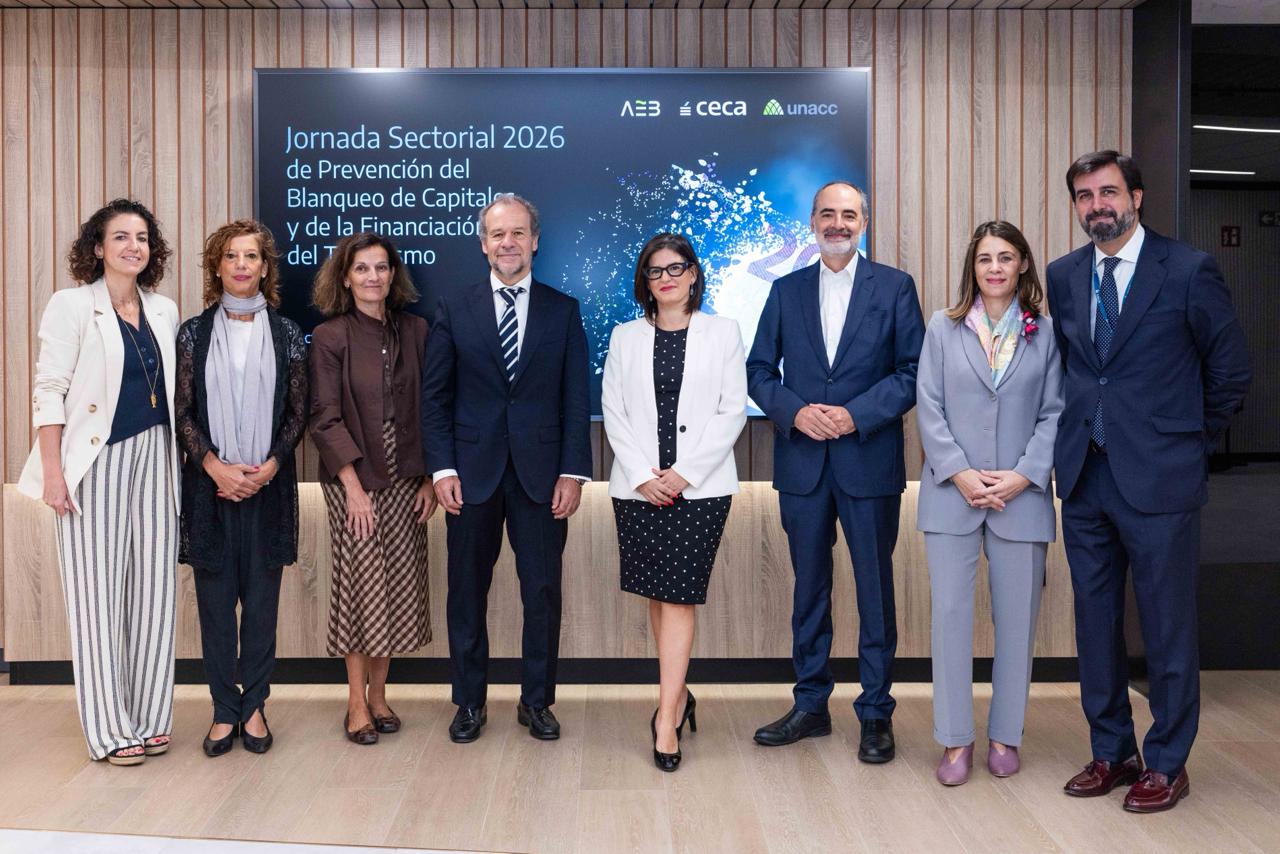
The credit institution associations AEB, CECA, and Unacc, in collaboration with Sepblac, held the tenth edition of the Sectoral Conference on the Prevention of Money Laundering and the Financing of Proliferation (ML/FT), which featured leading experts in the field, as well as representatives from supervisory bodies and the main regulatory authorities.
The meeting, held at CECA’s headquarters in Madrid, focused on the cooperative and coordinating role of the new European Anti-Money Laundering Authority (AMLA) and its progress over the past year in the areas of financial intelligence, supervision, and regulatory powers. The meeting also addressed the FATF’s visit to
Spain: recent developments in supervision and inspection; emerging types of money laundering and illicit financing; and the most relevant regulatory and supervisory architecture issues, such as the proposed Financial Integrity Authority (ANIFI), the National Council of PBCFT, and Level 2 developments under the AMLA.
The event brought together key representatives from the Treasury, SEPBLAC, the National Police, and the Civil Guard, as well as from the financial institutions that are members of the organizing associations, all of whom specialize in AML/CFT. They discussed the latest regulatory developments, new risk profiles, and emerging trends in the field of money laundering.
The meeting was opened by Irene Sánchez, an advisory member of the Treasury’s Subdirectorate General for Inspection and Control of Capital Movements, who highlighted the challenges that the private and public sectors will have to face together in the coming months, noting the mutual evaluation by the Financial Action Task Force (FATF), which will conclude in 2027 and will assess the state of Spain’s preventive system.
AMLA Vice President Juan Manuel Vega Serrano delivered a special presentation on the European authority and its strategic roadmap to strengthen anti-money laundering supervision and facilitate the coordination of financial intelligence. In this regard, he highlighted the authority’s role in fostering coordination and cooperation, as well as the digital challenges it faces.
This was followed by three roundtable discussions focusing on supervision and inspection, financial intelligence, and regulatory developments, respectively, with representatives from both the public and private sectors participating.
The first panel discussion, focused on the latest developments in supervision and inspection, was moderated by Alfredo Oñoro, CECA’s Director of Compliance. Speakers included Alejandro Valiñas, head of the Inspection and Supervisory Methodology Division at Sepblac; Juan Casillas, head of the Financial Institutions Inspection Unit at the same agency; and Raquel Cabeza, corporate director of Risk and Compliance at Cecabank.
The three presented the conclusions drawn from the most recent inspections, as well as the findings identified and the upcoming challenges of the inspection plan, highlighting the importance of coordination between national and European supervisors in a context where the new AMLA authority will begin to assume its responsibilities.
The second panel discussed the most significant developments and trends in the field of financial intelligence. The discussion was moderated by Cristina Freijanes, UNACC’s secretary general, and featured Juan Carlos Calleja, head of Sepblac’s Strategic Intelligence Division; Santiago Álvarez, chief inspector of the Central Financial Intelligence Brigade, a unit attached to the National Police; Carlos Cadiñano, lieutenant colonel and head of the Civil Guard’s Attached Unit; and Miriam González, director of Quality Assurance at BBVA’s Investigation Unit.
The panel focused on what is known as “crime as a service,” which reflects the growing professionalization of money laundering activities. Detecting this type of activity is not easy, so the session provided an overview of the phenomenon, an explanation of its characteristics, and some behavioral patterns that can trigger alerts in detection systems. To illustrate this type of activity, real-world operations were presented, along with the steps taken from the moment information is received via a tip-off until the final outcome of the operation.
Finally, the third panel was moderated by María Peco, senior advisor on Legal Affairs and Anti-Money Laundering at the AEB. Participants included Sandra Oliva, Area Coordinator of the Treasury’s Subdirectorate General for Inspection and Control of Capital Movements; Belén Álvarez, an AML/CFT expert in the Non-Financial Entities Inspection Division and Technical Secretariat of SEPBLAC; and Javier Oliveros, Director of Compliance at Caja de Ingenieros.
This roundtable analyzed the main organizational changes planned and recently implemented at the national level—with a special focus on the creation of the new ANIFI and the establishment of the National Council for the Prevention of Money Laundering—as well as at the international level, and discussed their impact on organizations. Likewise, progress was reviewed regarding the adaptation and transposition of the EU regulatory package and second- and third-level regulatory developments. In addition, the status of the FATF evaluation, the steps already taken, and the projected timeline were discussed.
The event concluded with remarks by Margarita Rufas, deputy director of SEPBLAC, who highlighted the contributions made during the roundtable discussions and emphasized the importance of maintaining a strong framework for cooperation among supervisors, authorities, and financial institutions.