Home / Latest News / You may be interested in / AEB Informs / María Abascal: Europe cannot stand still in the race for competitiveness
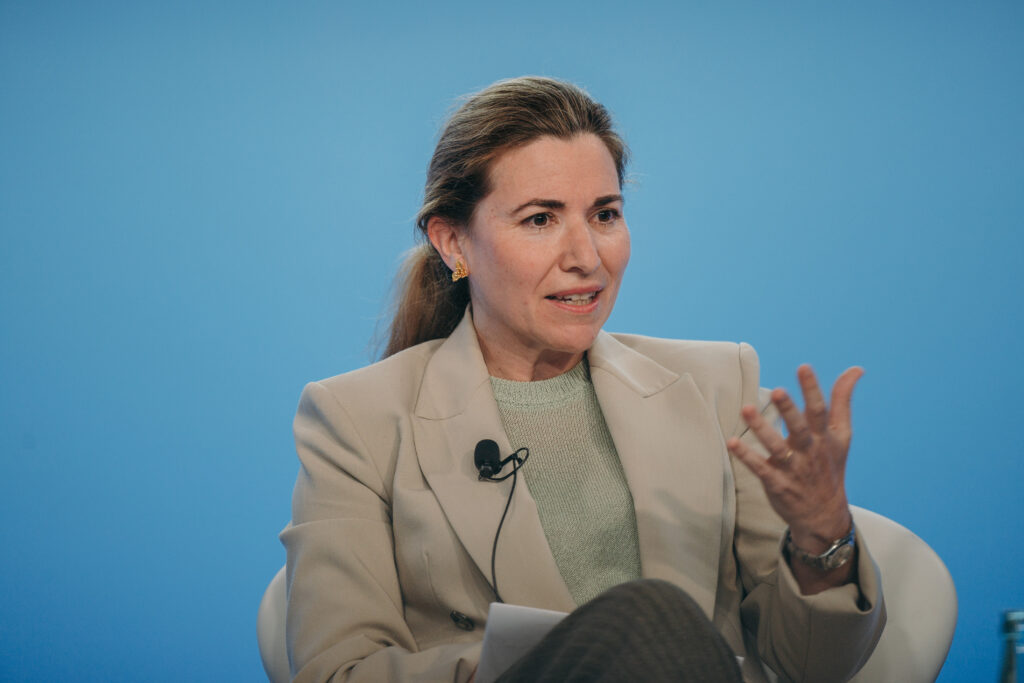
The director general of the Spanish Banking Association (AEB), María Abascal, stated in Frankfurt that the commitment to competitiveness is not a sectoral request of the banking sector, but a cross-cutting demand of the entire European industry, and warned that “Europe cannot stand still if it wants to consolidate its economic power” in the current global environment.
At the ECB and European Commission conference ‘European Financial Integration’, he advocated that the authorities should prioritize economic growth alongside financial stability, and adopt measures to modernize banking supervision and regulation. The aim is that banks can deploy their full potential to finance families and businesses, and Europe’s strategic needs: from sustainability, to innovation, to defense and strategic autonomy.
Other jurisdictions are taking measures to strengthen the competitiveness of their financial sectors, as in the United States or the United Kingdom, which have resulted in lower capital requirements. “It is not a question of lowering standards in Europe, but of revising the frameworks to support innovation and growth,” explained the AEB CEO.
At the roundtable discussion led by Frank Elderson, member of the Executive Board and vice-chairman of the ECB’s Single Supervisory Mechanism, Abascal pointed out that capital requirements in Europe have continued to increase in recent years, not only because of legislation, but also because of the greater weight of supervisory discretion. In this regard, he stressed that European banks do not need more capital.
In this context, he has opted for:
The also chairwoman of the executive committee of the European Banking Federation (EBF) has warned that Europe will not be able to meet all its long-term investment needs with a fragmented banking system and incomplete capital markets.
Specifically, he lamented the lack of regulatory harmonization in the EU, which generates different supervisory interpretations and national requirements, for example, in data processing and customer registration, anti-money laundering rules, consumer and investor protection, and debt collection and credit reporting frameworks, among other aspects.
A fully integrated European financial market would not only mobilize capital more efficiently, but also strengthen productivity, innovation and resilience, making the European economy more competitive on a global scale and less dependent on fragmented national solutions, he explained.
“If Europe wants growth, it must prioritize competitiveness,” Abascal stressed in a dialogue with Jonás Fernández Álvarez, member of the European Parliament’s Committee on Economic and Monetary Affairs; Britta Schmidt, senior analyst at Autonomous Research; and Ignazio Angeloni, senior policy researcher at the Leibniz Institute for Financial Research SAFE (Sustainable Architecture for Finance in Europe).