Home / Latest News / You may be interested in / AEB Informs / “Why should dividends be canceled for strong banks that are providing credit?”
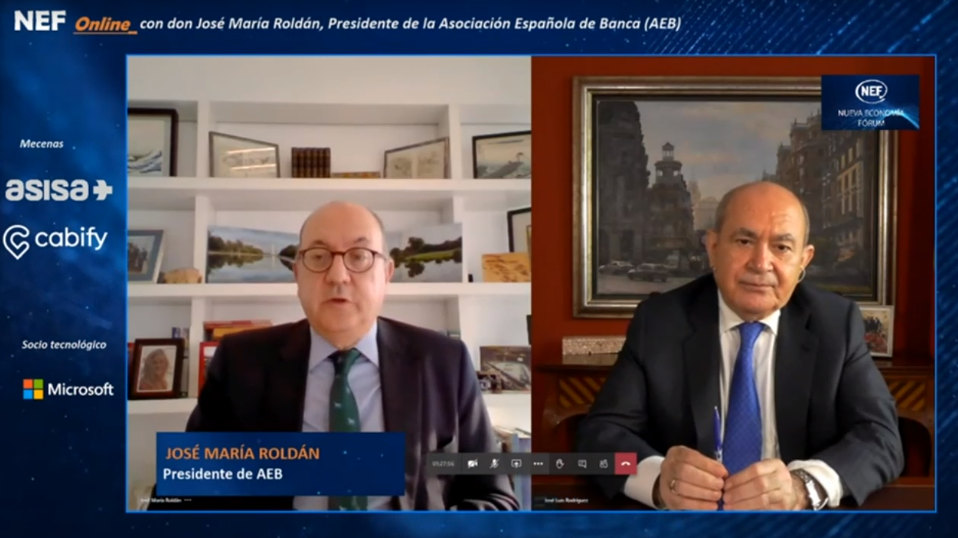
“I want to thank the Minister of Labor for her words of recognition regarding the work carried out by banks with the ERTEs. I hope that from now on this becomes increasingly frequent.” This was how the president of the AEB today assessed the Government’s gratitude to the banking sector during his speech at the Nueva Economía forum for its measures to help the families and companies hardest hit by the health crisis.
“Banks must be criticized when they make mistakes, but also recognized when they do well. Constant criticism sends a bad message: no matter how you do it, I will always censure you. That leaves banks with no incentive to improve every day,” stressed José María Roldán, expressing his appreciation for the words of Minister Yolanda Díaz during her appearance in the Congress of Deputies.
More than 400,000 companies, most of them SMEs, have benefited from ICO-guaranteed loans, thanks to banks making €100,000 million of their liquidity available to their clients and their entire network to carry out 565,000 operations in record time, he detailed during the digital meeting.
“We have managed to reach the productive fabric very quickly, because we know that the more companies with temporary difficulties survive, the faster the recovery will be and the fewer jobs will be lost,” Roldán maintained. “We are fully committed to helping our clients. The only limit that cannot be crossed is the strength of the balance sheet. If we do, it will have serious consequences for the real economy.”
After assessing the reaction of the European authorities to the early stages of the health crisis, the president of the AEB advocated for measures adapted to the situation of each bank regarding shareholder remuneration. “If a bank is providing credit and has a strong balance sheet, why must it cancel its dividend?” he asked. “Those generalized recommendations help the worst entities and harm the best ones. We must analyze on a case-by-case basis.”
Regarding possible future measures in the regulatory and supervisory field, he suggested that “perhaps the bankruptcy regulations need to be changed so that public creditors have fewer privileges and are in a more balanced position with private ones. It is time for everyone to pull their weight.”
Also in relation to the public sector, he warned that “state aid will introduce serious distortions in the functioning of the Single Market, which is the crown jewel of the European Union. We cannot allow it. European companies must compete on a level playing field.”
The president of the AEB thus emphasized the importance of ensuring a fair playing field in the new scenario that opens up after the health crisis, even if it involves the creation of state banks. “We are not afraid to compete and coexist with potential public commercial banks, but as a taxpayer, I do have my doubts in light of recent experiences.”
José María Roldán also made clear the fierce competition that characterizes the Spanish banking sector: “There is no banking oligopoly in Spain. Our banks compete savagely with each other and also with the new digital operators that are entering this market en masse.”
Faced with the possibility that a bailout of Spain might be necessary, he was categorical in denying it. “It is not necessary; we know what we have to do to maintain market confidence, such as a medium-term plan to reduce public debt. It is better for us to do it ourselves than to have it imposed on us from outside,” he concluded.
José María Roldán, Chairman of the Spanish Banking Association