Home / Latest News / You may be interested in / AEB Informs / “Liquidity for businesses has come out of the banks’ own pockets”
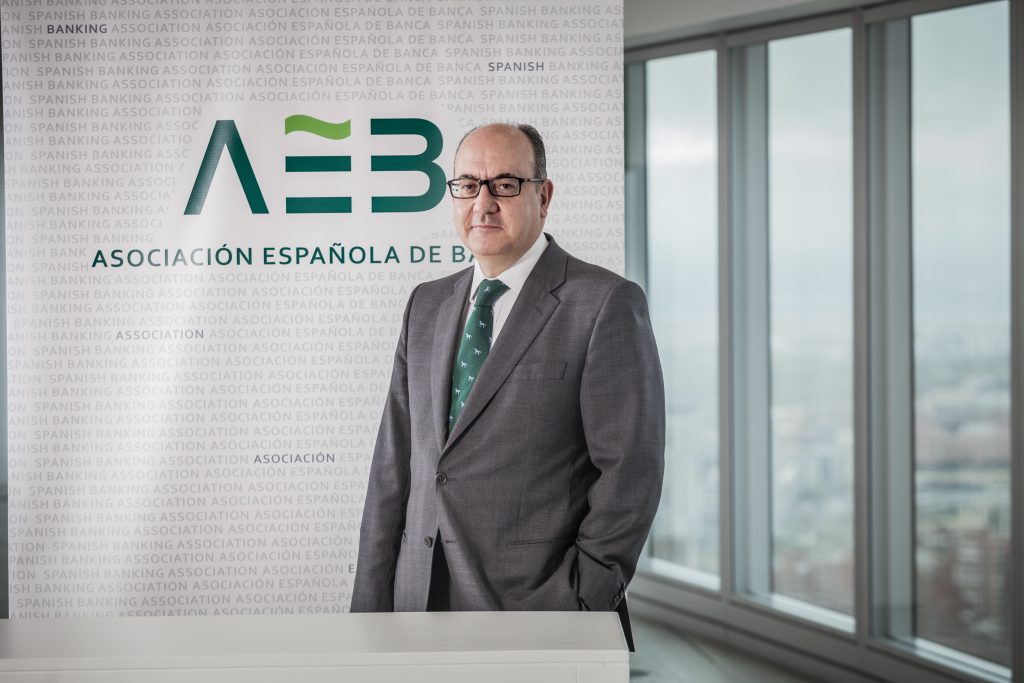
José María Roldán, President of the Spanish Banking Association (AEB), an organisation with more than 40 years of history that brings together institutions such as Santander, BBVA, Sabadell and Bankinter, meets with Economía 3 and says he is proud of how the banking sector is “pulling its weight” in this crisis, knowing that if in 2008 it was part of the problem, it is now part of the solution.
However, he asks the Government to maintain market confidence in the solvency of the Spanish state, which requires being “rigorous with public finances” and showing that we are willing to reduce our deficit and debt over the medium term.
How would you define the banking sector’s starting position to address this crisis?
Fortunately, it has caught the sector far better prepared in terms of liquidity and capital than it was when the 2008 crisis broke out. In addition, there is the experience—and I believe this is the most important—of having come through a crisis as tough as the previous one, which changed so many parameters for banking. In reality, that crisis, still so recent, ushered in a new reality for all of us. That is the experience we are drawing on.
At first, Spanish institutions focused on injecting liquidity into businesses; offering families payment holidays beyond those regulated by law; bringing forward the payment of pensions and unemployment benefits… How would you describe this effort?
I do not want to bore you with figures. But to refer only to the most ambitious programme, the ICO-guaranteed loans, we have carried out around 620,000 transactions, 97% of which were aimed at small and medium-sized enterprises, injecting a total of €77 billion. The most important thing is that we did it quickly, because arriving when the company has already gone under is of no use. And that speed has been possible because our banks have made their branch network and staff (most working from home during lockdown, but many also serving customers in person in branches) available to their customers. Liquidity has also come out of our institutions’ own pockets (€100 billion), preventing the Spanish state from having to go to the markets for this reason and leaving that effort to meet other needs.
Now, in this new normal, what should banks focus on most?
On continuing to serve their customers professionally. Going as far as possible without putting the solvency or stability of the financial system at risk. We all know the very serious cost to society when that fails.
Do you think banks have been sufficiently rigorous in assessing risk when granting ICO-guaranteed credit, or do you think public support has made it possible to back transactions that otherwise “would not have gone ahead”? Could this become an unforeseen problem in the medium term?
Our banks are very rigorous in risk analysis. In fact, that is their core job. However, granting a loan is not the same when you bear all the risk as when you assume 20%, 30% or 40% of the risk, as has been the case in this programme. It is easier and you can go further. In reality, this programme has been an excellent example of public-private collaboration, a path we will have to persevere with if we want to move the country forward.
Do you have an estimate of how much non-performing loans could increase among businesses and households? Could it reach the levels of the previous crisis?
No, we do not have an estimate of how non-performing loans may evolve. It depends on how the economy evolves, and nobody knows that yet.
Other countries have adopted other types of instruments and support (subordinated debt, subsidies, capital injections…). Do you think they could be well received in Spain and that their effect could be positive?
Yes, I genuinely believe it would be very positive for the Spanish state to be able to provide greater support to our country’s business fabric through direct aid, as other EU Member States are doing. Public aid in Spain is far lower than in other countries around us, which means our companies will have to compete at a disadvantage. That is not fair. A German company, for example, should be able to compete with a Spanish one on the quality and price of its offer, not because it has public money backing it. It is very worrying that the rules governing state aid have suddenly disappeared, without any explanation, because it has suited some countries that have fiscal room to use it in these cases. The blow to the Single Market—the crown jewel of the EU—could be very severe, and what has been destroyed in this crisis will have to be rebuilt afterwards.
In the case of institutions, how have they managed to defend margins?
Our institutions are already experts at managing this situation of very low and even negative interest rates. It seems like a miracle, but they achieve it year after year, even improving profitability. It is a very fine-tuned management approach, seeking out the most profitable niches and, above all, reducing costs. They achieve the latter thanks, among other things, to the very intense digitalisation process that has taken place in recent years. Digitalisation has a dual benefit: on the one hand, it reduces costs and, on the other, it provides better customer service—faster, more convenient and tailored to their needs. Our banks have been pioneers in this process, investing a great deal of money and effort. And they have not been wrong. The COVID-19 crisis has shown us that they were on the right path. That effort has enabled them to continue operating without incident during the months of lockdown. Everything has worked well. The payments system, an extremely delicate part of any economy, has remained standing, and customers have been able to be served as normal, even though the circumstances were anything but normal.
Profitability will undoubtedly continue to be one of the major challenges. How can it continue to increase with the current yield curve and without more favourable expectations? How are Spanish banks performing compared with Europe?
Our banks are above the European average in terms of profitability and were approaching the cost of capital when the pandemic broke out. We hope to continue along that line in the coming years, although the problem with this health and economic crisis is that it does not allow projections to be made, for the time being. And managing a bank, a company, like that is very difficult.
However, in terms of solvency (CET1 fully loaded), we come off worse than European institutions…
It is true that we are below the European average in terms of capital measured by risk-weighted assets. But if we exclude that type of weighting—which penalises our banks greatly because they do commercial banking and because of their diversification in Latin America—and we take the leverage ratio, that is, we relate all our own funds to our assets, then our banks are among the best in Europe. If we also relate equity to the balance sheet, our institutions have the highest index. We are not in a weak position at all. In my view, capital should be reasonable in line with the risks and the business model.
Do you think that, based on their profitability and solvency, some Spanish institutions would be in a position to pay a dividend this year if Europe’s ban is not extended?
I do not know the accounts or the plans each institution may have in this regard. But I do believe they should be allowed to make that decision, or else, if the supervisor considers that one should not do so because of its specific situation, it must set this out and justify it with the institution in question. A one-size-fits-all approach is not good in this case, because it casts a shadow of doubt over the sector as a whole and that penalises institutions in the market. It is necessary to differentiate, to separate what is in better shape from what is not as much. That helps the institution that is doing poorly to improve and does not unnecessarily punish the one that is doing well.
What measures would the banking sector contribute to underpin the recovery?
The word is financing: credit for solvent customers, including those going through temporary difficulties. In addition, we are open to supporting the programmes the Government proposes. So far, it has been shown that public-private collaboration has not only worked well, but is essential to deal with situations as complex as this one.
In this regard, do you think there is room for new taxes on banks?
There is no reason to introduce additional taxes on banks. We do not understand why it is necessary to discriminate against this sector compared with others. We do not want preferential treatment, but we do not deserve an extra penalty either. That certainly does not help banks perform their function, which is already difficult enough.
With a view to the aforementioned reconstruction, what would you warn about, or where do you see particular weakness?
I am concerned about Spain’s high external debt. So far, the Treasury has been going to the market without problems to roll over maturities or issue new debt, and it is necessary to keep it that way. That is, to maintain market confidence in the solvency of the Spanish state. To do so, we must be rigorous with public finances and show that we are willing to reduce our deficit and debt with a reasonable medium-term programme.
Another issue of interest to banks is the entire regulatory process. What remains pending?
The regulation put in place after the international financial crisis is practically complete. It has served to strengthen banks’ balance sheets, but it is time to undertake a review and simplification of regulation which, as is being shown, does not help to overcome crisis situations and in some cases, as with resolution rules, will never be applied. Not to mention directives such as MiFID, which, with more than 7,000 pages, has proven impossible to implement. We need to move towards quality regulation—regulation whose application and supervision, if not easy, is at least possible. And this is the right time to do it.
How is the banking sector dealing with the opening of banking activity to new technological competitors (telecommunications operators, bigtech…) and, in turn, how is banking transforming into a provider of products rather than services, from traditional leasing and insurance sales to mobility, technology elements…?
We have no problem with fintech, with which we are collaborating and finding numerous synergies. These companies are very agile, have no baggage from the past and can innovate easily, just like banks, which also have networks and customers. The problem lies with the bigtech, which are entering the profitable niches of the financial business with great force without having to bear the extremely costly and demanding banking regulation. We only ask to compete on a level playing field. Same activity and risks, same regulation and supervision. This is also very important for users of financial services, whose rights as consumers are less protected when they operate with a bigtech than when they do so with a bank. All of that needs to be fixed. Finally, let me highlight that in these very critical months, with businesses and families struggling, we have seen banks working and providing help and services, but not a single bigtech, nor entities in so-called shadow banking. When times got tough, banks were there, pulling their weight. And they will continue to be there.
José María Roldán, Chairman of the Spanish Banking Association