Home / Latest News / You may be interested in / AEB Informs / Interview with José María Roldán in Expansión
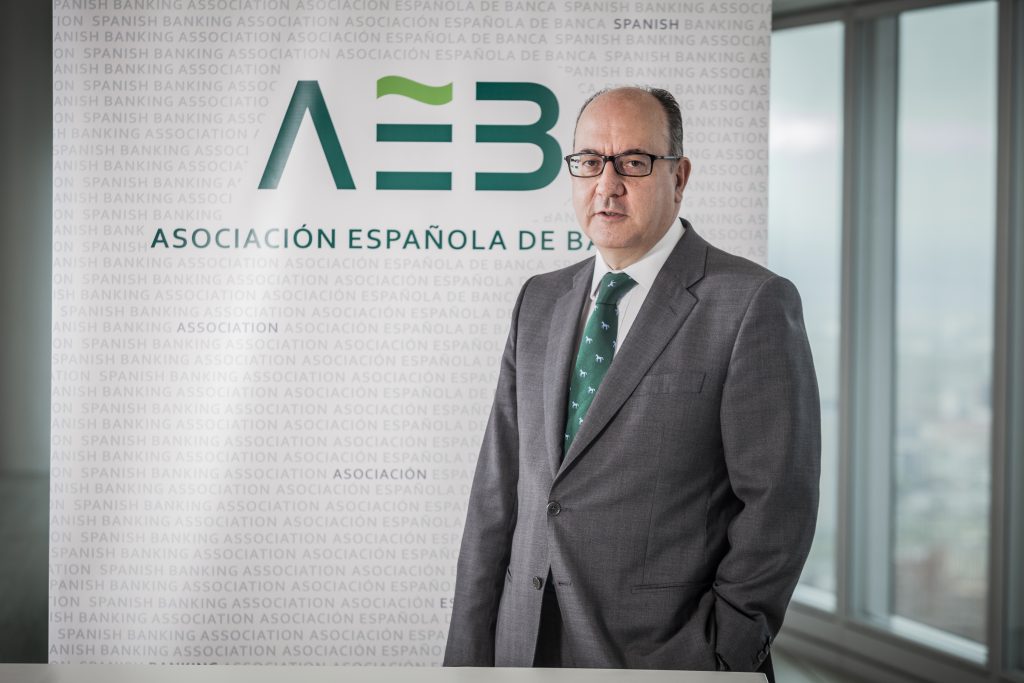
An anomaly that was temporary has become something structural, says José María Roldán, president of the banking association AEB, regarding ultra-low interest rates in the eurozone. Despite the complexity of the situation, he acknowledges that banks can operate, although they will have to offer new services to clients and charge for them.
“In situations of pressure is when Spanish banks bring out the best in themselves.” This is how the interview begins with José María Roldán (Teruel, 1964), who has been presiding over the banking association for five years and serving as vice president of the European Banking Federation for four. He is a civil servant at the Bank of Spain, where he served as Director General of Regulation and Financial Stability for thirteen years. He was one of the first senior Spanish officials with direct communication with the ECB.
How will the banks’ income statements withstand several more years of negative interest rates with the wear and tear already accumulated?
The yield curve indicates eight years of very low rates. An anomaly that was temporary has become almost structural. But of course we can operate in an environment like this. It is very complex, but we have done it in the last three years and we will continue to do so in the following ones. The sector has been able to maintain margins and improve its profitability to levels of 6%-7%, something very reasonable with negative nominal rates.
But what about those levers, such as cost cutting—aren’t they somewhat exhausted?
We will then have to think about how to offer services to clients that they do not currently have and study how to use digital platforms to increase efficiency. The difference between a good and a bad institution is seen in this type of circumstance.
Does the future involve exploring non-banking fields such as the sale of mobile phones and appliances, as some institutions are doing to increase the consumer financing pie?
That has more to do with the convergence of business models. There will be segments that will remain banking, such as SME financing, because knowledge of the client is fundamental; but others will not. Here, the consumer experience will be crucial. We also request regulatory symmetry. With the PSD2 [payments] directive, banks have to provide access to our clients’ banking data to third parties and pay for the IT bridge that enables it. Why doesn’t this happen in reverse? I know of no other sector where this has occurred.
Is the banking sector considering charging for services that are currently free in Spain but not in other countries?
It is vital to offer clients services that they do not currently have and for which they would be willing to pay. Japan did this when it experienced a long period of low rates. What would they be in Spain? I do not know.
But Spanish banks find it very difficult to implement new fees. Until recently, they did not begin charging for ATM use to non-clients. And there are several institutions that have decided to absorb the higher costs legally required for signing a mortgage.
Because competition in this sector remains brutal. It is a very dynamic market, where only the best will survive. It is part of our DNA.
A very obvious lever for cutting costs is mergers. But what do we do if the banks that attempt them do not complete them because they resist ceding areas of power?
Size is not everything. There have been small institutions with acceptable profitability and there will continue to be. That said, I believe it is a path that should be explored in scenarios of low economic growth and increasing digitalization. In my opinion, the process of rationalizing structures has not yet reached its end in Spain.
Is the possibility of Spanish banks achieving coverage of their capital cost with business profitability being postponed indefinitely?
What is increasing is the level of demand to approach that 10% which is calculated to be the cost of capital for banking. That 10% is like a cosmological constant that has not moved since before the crisis.
Governance is also essential. The ECB has requested greater dedication to this task from non-executive directors of banks. It currently occupies them an average of 22 days per year, according to its statistics. Any self-criticism to offer?
I am sure it is not only a Spanish problem. In any case, if we ask them for more dedication, knowledge, responsibility, and independence, the next step is to consider that their remuneration must be in line with those requirements. Otherwise, we are asking for the impossible.
Tomorrow marks two weeks since the publication of the EU Advocate General’s report on the IRPH mortgage index. Roldán believes that the markets gave a first “biased and superficial” reading of its conclusions and is confident that the ruling, which will arrive in 3 or 4 months, will be favorable to the sector’s interests. Roldán recalls that mortgages with IRPH apply a much lower spread than those linked to the Euribor. “Today a person with an IRPH loan is paying a better rate than that applied to new mortgages,” he states.
If the Court of Justice of the EU follows the Advocate General’s recommendation and leaves transparency control in the hands of Spanish judges, would that be good or bad news for the banking sector?
It would be positive insofar as the Supreme Court already stated at the time [December 2017] that the index was not abusive.
Do your members meet the two conditions set by the Advocate General to consider a loan with IRPH transparent?
In general, the perception we have at AEB is that there would be no problems with those two conditions.
If the sector had to make provisions, would they be even higher than those made for floor clauses, which were around €2,000 million?
To speak of provisions now would be reckless. What seems important to me to point out is that the most extreme assumptions included in some of these investment bank analyses would not apply if the European court confirms the Advocate General’s criterion.
In the last year, the number of client complaints regarding revolving cards has increased significantly. Mainly against WiZink, but there are also complaints against other banks. To what extent could this become a significant legal front for the sector?
For now there are rulings in both directions and there is still no clear jurisprudence from the Supreme Court, nor is it expected soon.
What do you think about institutions charging a client up to 28% APR for financing with a revolving card?
The cost depends on the risk of each transaction and the degree of immediacy of the financing. The important thing is to know whether or not the client understands what they are contracting. That said, it must be added that access to certain types of loans is important for certain segments of the population and that credit activity is free in Spain. That is, it is not only offered by banks. If in the future this business ceases to be profitable for banking because the conditions are unviable, the activity will shift to shadow banking, where controls and consumer protection are worse. The rates they apply are also infinitely worse, only they are not discussed because there is no established complaints channel.
Regarding a hard Brexit, he states that “Banks are accustomed to living through periods of economic crisis and bad cycles do not last indefinitely. Institutions have perfectly honed defense levers to deal with an environment of lower growth in the United Kingdom, in Spain, or in any other country.” “What concerns us most [about Brexit] is the volatility it can create in the markets and the impact on global growth, but it is a sovereign decision of the United Kingdom,” he adds.
What has failed for Spain not to have been able to attract more financial industry?
Perhaps the problem was in generating the expectation that Madrid was going to be the new London.
Interview with José María Roldán, president of the Spanish Banking Association, conducted by Raquel Lander