Home / Latest News / You may be interested in / AEB Informs / “The new mortgage law will introduce rigidities”
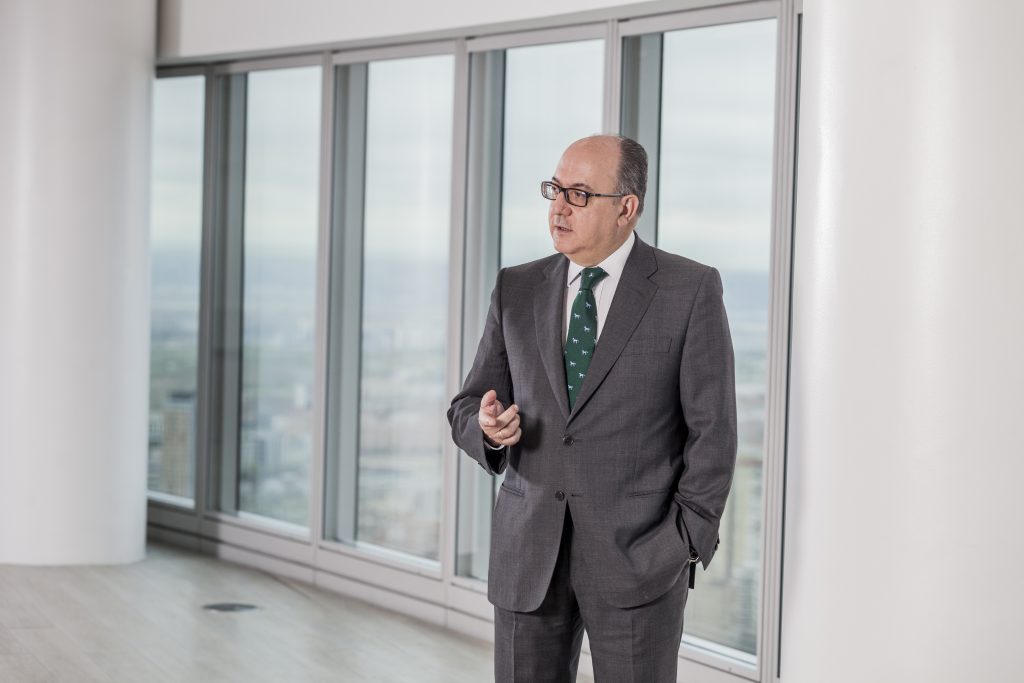
José María Roldán, president of the banking association AEB since 2014 and previously a senior official at the Bank of Spain for many years during the worst of the crisis, defends a financial system suffering one of its lowest moments of reputation, following the controversial reversal by the Supreme Court regarding its initial ruling that customers should stop paying the documented legal acts tax on mortgages and the subsequent government decision that entities should pay it. The business leader assures that the sector has limited itself to complying with legislation at all times and warns of the effects of recent regulatory changes on credit for home purchases.
What is your opinion of the new mortgage law approved by Congress?
It will introduce greater rigidities. In some aspects there are improvements, but in others we are moving away from European standards, such as in mortgage foreclosures. There are matters where common sense has prevailed, such as in fixed-rate mortgages. If cancellation fees had been prohibited, these loans would have ceased to exist.
What effects will the change in the tax have?
The effect depends on the elasticity of supply and demand curves or, in less technical terms, it will depend on the strength of housing demand and the degree of competition in the sector, which remains very strong. But economic theory also tells us that an increase in costs leads to lower volumes and higher prices, and again the impact will be greater or lesser depending on those supply and demand curves. Spain is the country where the non-financial costs of a mortgage are highest, mainly due to taxes. It makes no sense for it to be this way. In any case, we must understand that there is no worse violation of a consumer’s rights than denying access to financing.
Has the controversy over the mortgage tax hardened the regulation?
Perhaps it has had an influence. But the most relevant thing is that we are adapting the EU directive and we are moving away from European best practices. I wish that instead of European directives we had regulations that are mandatory for countries to comply with.
Have you been able to influence parliamentary groups?
The times are very complex and sometimes it is difficult to get messages across. Some have resonated and others have not. But we have done what we had to do, which is to explain things.
Will the law reduce litigation between banks and customers?
Let us hope so, otherwise we will have failed, not only as a sector, but also as a society. The mortgage loan already provided the highest guarantees to the consumer, with the intervention of the notary and the registrar. I would never have thought two decades ago that litigation would occur precisely in something so well guaranteed.
Many courts are overwhelmed by mortgage litigation.
Banking is based on a relationship of trust with customers; judicial proceedings are not comfortable for them or for banks. The problems come from the crisis and its consequences, but also from the fact that an American-style litigation model has been imported, with class actions. If this model is adopted, procedures must be established to prevent the collapse of the courts, but we are not responsible for this nor is it our responsibility to resolve it.
Why do you not feel responsible, having so many rulings against you?
Because new legal standards are being applied to previous situations. That is why we warn of the legal uncertainty problems caused by retroactivity on mortgage portfolios. Improvements can certainly be introduced in the market, but the Spanish consumer has not been treated worse than the European consumer. Spain is a country with a high level of home ownership and a relatively moderate mortgage balance compared to other countries where perpetual mortgages exist. We must defend the stability of the sector and emphasize the need for strong banks capable of absorbing the problems of the crisis when they come and financing recovery.
Does warning about the macroeconomic effects of rulings not imply defending that it is better not to touch certain things even if they are wrong?
There is a judicial philosophy that says you should not take these types of impacts into account because that would make you lose the impartiality of justice. I am not a lawyer, I am an economist. I think it is important that judges consider these impacts within the parameters of their decisions and not only take technical issues into account.
At the time you denied that the banking sector influenced the Supreme Court’s decision to reverse its position on the mortgage tax
There would not even have been time for that. The ruling was announced on a Thursday with the market open. We spent that entire day trying to understand its scope. And on Friday morning the decision of the chamber to refer the change of criteria to the full court was already announced.
Could there have been pressure not from AEB but from its member banks?
I am not aware of any. And that is not our way of operating.
Then what do you attribute the Supreme Court’s reversal to?
It is the reaction of the markets that draws everyone’s attention to the impact of the decision. Banks lost approximately 6,000 million euros in market value in a very short time, which represents a very high percentage of their stock price. Markets are unforgiving. You cannot call them thieves one day and ask them for financing the next. Spain, as a country with very significant external debt, must be mindful of market developments.
It gives the impression that you feel like victims of that controversy.
The paradox of that entire situation that has damaged our reputation is that we were completely passive agents. We have done nothing more than comply with legislation and jurisprudence that had been in place for several decades. There was a change in a very well-established criterion and we were surprised by an unfair avalanche.
One of your objectives when you arrived at AEB was to improve the sector’s reputation, which is at a low point.
The problem is much more complex than we thought. It improves at the speed at which a palm tree grows and is lost at the speed at which a coconut falls, sometimes due to external factors. We must continue improving our culture and practices to adapt to a much more demanding environment, while continuing to defend legal certainty.
“Supervisors are increasingly acting with less freedom”
Proper management of the next crisis is key for José María Roldán. The president of AEB is concerned that supervisors have less and less room for maneuver and also that Spain will make mistakes in the coming quarters that will leave it in a worse position when problems return.
Has the congressional investigation committee been useful?
First of all, I want to express my respect for it. But analyses about what would have happened if we had known then what we know today seem of little use to me. They focus heavily on the autopsy of the last crisis and little on future crises.
Is the action of supervisors being restricted?
It is a global trend. Supervisors are increasingly acting with less freedom. The legal and institutional environment restricts them. Many have been charged in courts. If as a regulator you see that by following your procedures no one criticizes you, you limit yourself to that. But in extreme situations, it is necessary for them to do things they would not do under normal circumstances. For the general interest, without thinking about personal consequences.
Has the criticism of the Bank of Spain been excessive?
I have spent too many years in that institution to have an objective judgment. In any case, it is our supervisor and we have great confidence and respect for it.
What do you think about the Bank of Spain being able to limit credit to prevent bubbles?
It was necessary to have a macroprudential authority, although we are very late compared to other European countries. That said, we must not forget microprudential supervision of each entity. And only when it is not sufficient is it time to resort to other macroprudential measures that affect the entire sector and not just specific entities.
Will banks withstand the next crisis better?
Banks are better prepared, more liquid and solvent. And our customers, families and businesses are less indebted. But let us not be complacent. As a country, we must focus on not unnecessarily complicating our lives.
Are you referring to politicians?
What I am saying is that we should not unnecessarily complicate our lives. Spain is one of the countries that has grown the most in recent years and we must try to maintain this for a few more years. The room for maneuver in fiscal policies, as well as monetary policies, is very limited.
Do you foresee more mergers and workforce adjustments?
Spain has made more progress than other countries. But scale continues to be important. Smaller entities face difficulties due to regulation, which is increasingly complex, and the digital revolution. As for the reduction of branch networks, it has slowed down although technological transformation makes it an unstoppable process. But no entity is proposing the closure of all branches. Other professional profiles are needed.
Does it make sense for there to continue to be two financial employers’ associations in Spain, AEB (traditional banks) and CECA (banks that are heirs to the savings banks)?
We are all publicly traded banks, with similar business models. The relationship is good. There is no urgency either. Circumstances are what they are and time solves everything.
José María Roldán, Chairman of the Spanish Banking Association